

Fewer than 10% of people who receive a Vedic birth chart ever learn to interpret it themselves, yet the chart contains a complete symbolic map of a person’s life, encoded in geometry, planets, and ancient Sanskrit wisdom. This guide on How to Read Your Kundali: A Beginner’s Step-by-Step Guide breaks that barrier. By the time you finish reading, you will understand the core building blocks of a Vedic birth chart well enough to follow along at any astrology consultation, and to begin exploring your own chart with genuine confidence.
Key Takeaways
- A kundali is built from three layers: the 12 houses, the 9 planets, and the 12 zodiac signs (rashis).
- The Ascendant (Lagna) is the most important single point in any birth chart, it sets the entire house framework.
- Each house governs a specific life domain, from self-identity to career to spiritual liberation.
- Planet placement, sign rulership, and house lordship all interact to produce nuanced readings.
- Arriving at a consultation with even basic chart literacy dramatically improves the quality of insights you receive.
What Is a Kundali and Why Does It Matter
A kundali (also spelled “kundli”) is a Vedic birth chart, a snapshot of the sky at the exact moment and location of a person’s birth. Unlike Western astrology, which typically uses a circular wheel, Vedic astrology (Jyotish) uses either a diamond-shaped North Indian grid or a square South Indian grid. Both formats contain the same information; only the layout differs.
The chart records:
- The positions of the 9 grahas (planets) across the 12 rashis (zodiac signs)
- The 12 bhavas (houses), each governing a distinct area of life
- The Lagna (Ascendant), which anchors the entire chart to the individual
“The kundali does not predict fate, it maps potential. The astrologer’s job is to help you navigate that map.”
Understanding this structure is the first step in any beginner’s step-by-step guide to reading a Vedic birth chart.
How to Read Your Kundali: Understanding the 12 Houses
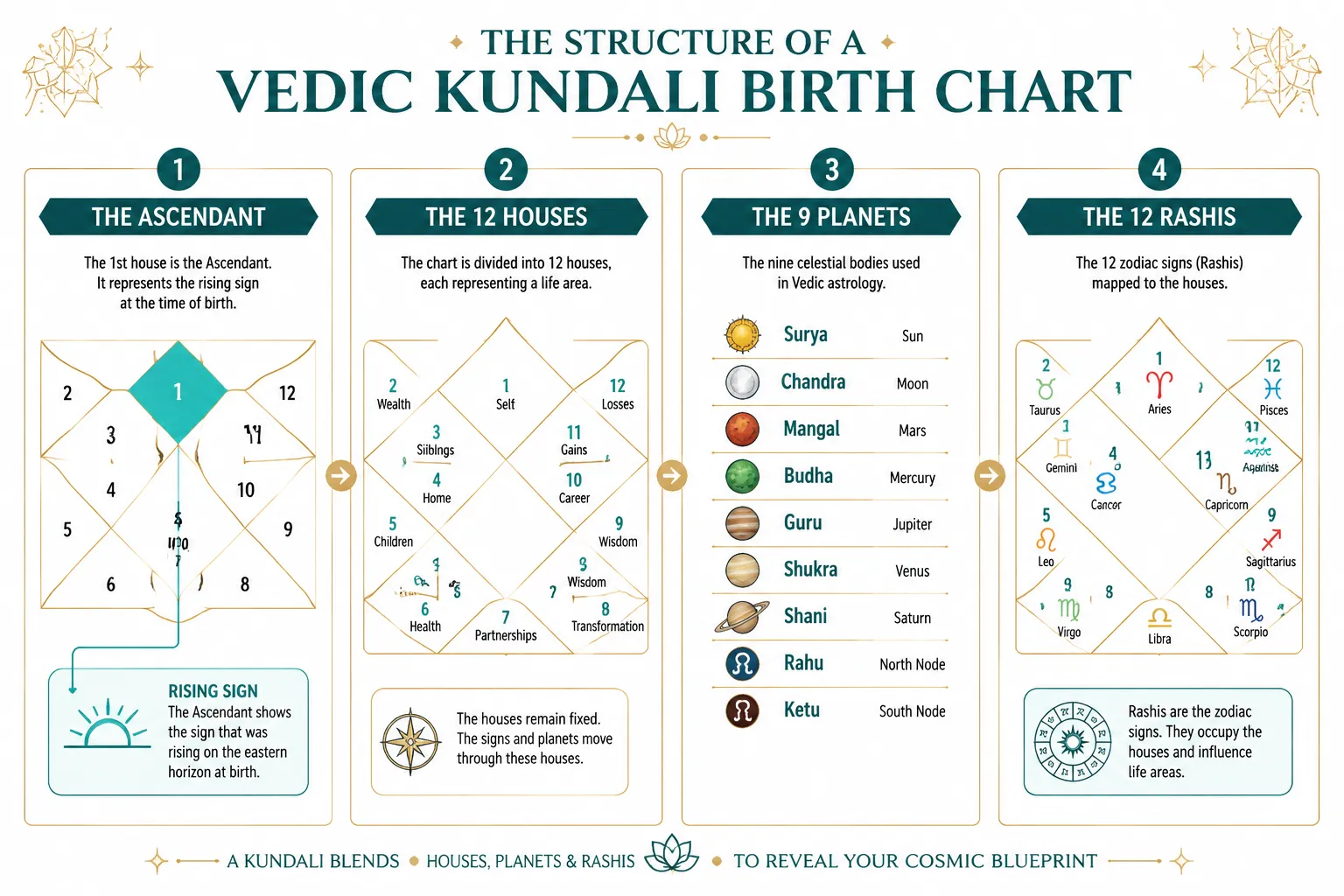
The 12 houses (bhavas) are the foundation of chart interpretation. Each house represents a specific domain of life. The house numbering always begins with the Lagna (Ascendant) and moves counter-clockwise in the North Indian format.
The 12 Houses at a Glance
| House | Sanskrit Name | Life Domain |
|---|---|---|
| 1st | Tanu Bhava | Self, body, personality |
| 2nd | Dhana Bhava | Wealth, speech, family |
| 3rd | Sahaja Bhava | Siblings, courage, communication |
| 4th | Sukha Bhava | Home, mother, inner happiness |
| 5th | Putra Bhava | Children, creativity, intellect |
| 6th | Ari Bhava | Health, enemies, service |
| 7th | Yuvati Bhava | Marriage, partnerships, contracts |
| 8th | Randhra Bhava | Transformation, inheritance, hidden matters |
| 9th | Dharma Bhava | Luck, higher learning, father |
| 10th | Karma Bhava | Career, status, public life |
| 11th | Labha Bhava | Gains, social networks, aspirations |
| 12th | Vyaya Bhava | Losses, liberation, foreign lands |
The Concept of Kendra and Trikona Houses
Not all houses carry equal weight. Beginners should memorize two special groups:
- Kendra houses (1, 4, 7, 10): The pillars of the chart, they represent action, stability, and worldly achievement.
- Trikona houses (1, 5, 9): The most auspicious houses, they represent dharma, purpose, and fortune.
Planets placed in kendra or trikona houses generally produce stronger, more positive results. Planets in the 6th, 8th, or 12th houses (called dusthana houses) require more careful interpretation.
Finding the Lagna (Ascendant)
The Lagna is the zodiac sign rising on the eastern horizon at the moment of birth. In the North Indian chart, it is always placed in the top-center diamond. In the South Indian chart, it is marked with a diagonal line or the word “Asc.”
Why the Lagna matters: It determines which sign rules each house. If your Lagna is Aries, then Aries rules the 1st house, Taurus rules the 2nd house, and so on around the chart. This is why two people born on the same day can have very different charts, the Lagna changes roughly every two hours.
How to Read Your Kundali: Planets, Signs, and Their Interactions
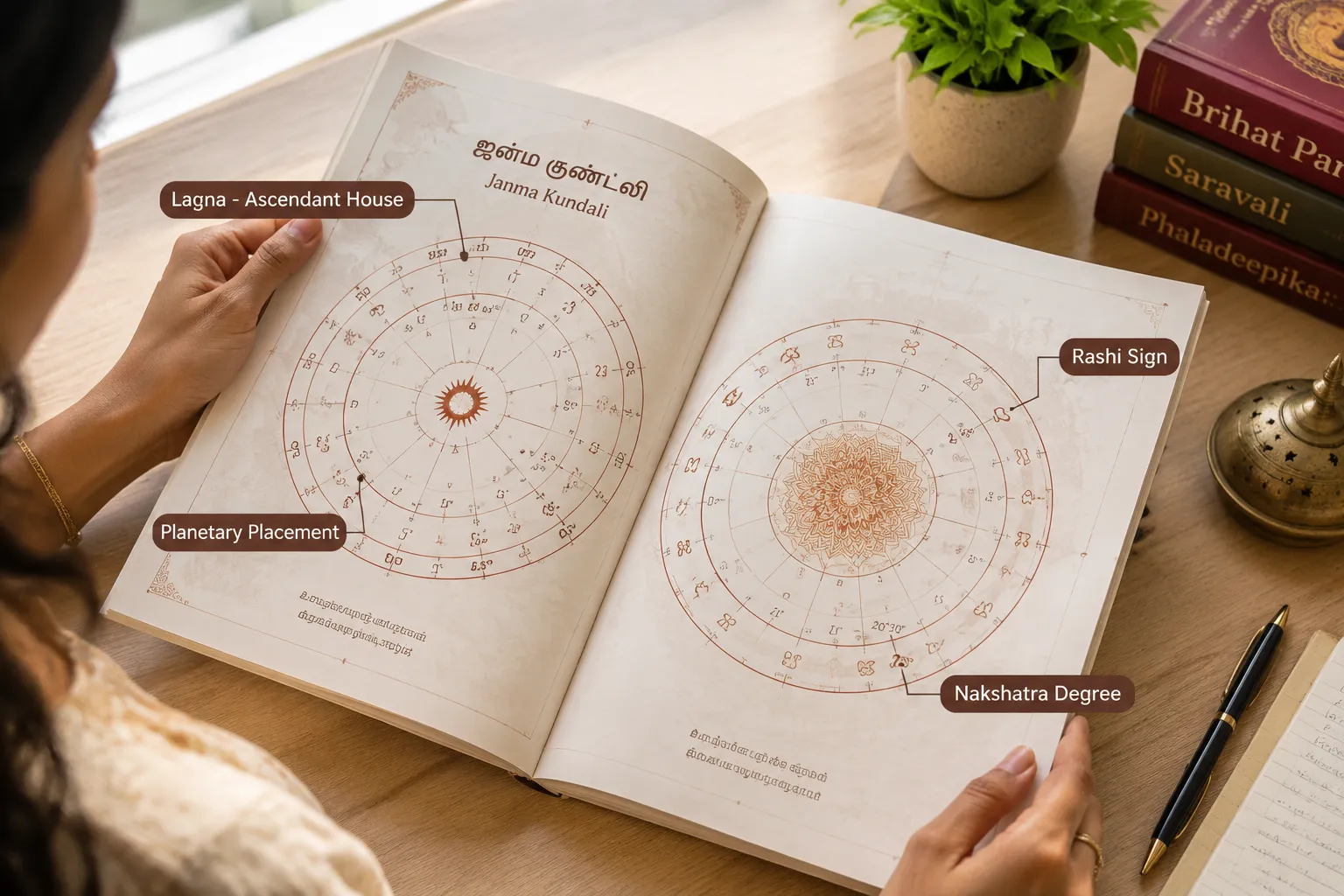
Once the house framework is clear, the next layer involves the 9 planets (navagrahas) and the 12 rashis (zodiac signs). This is where chart reading moves from structure to story.
The 9 Planets in Vedic Astrology
Vedic astrology uses 9 grahas, not the full solar system. These are:
- Surya (Sun), Soul, authority, father, vitality
- Chandra (Moon), Mind, emotions, mother, intuition
- Mangal (Mars), Energy, courage, conflict, property
- Budha (Mercury), Intellect, communication, business
- Guru (Jupiter), Wisdom, expansion, spirituality, children
- Shukra (Venus), Love, beauty, luxury, relationships
- Shani (Saturn), Discipline, karma, delays, longevity
- Rahu (North Node), Ambition, illusion, foreign influences
- Ketu (South Node), Detachment, spirituality, past karma
Rahu and Ketu are mathematical points, not physical bodies, but they carry significant interpretive weight in Jyotish.
Natural Benefics vs. Malefics
| Category | Planets |
|---|---|
| Natural Benefics | Jupiter, Venus, waxing Moon, Mercury (unafflicted) |
| Natural Malefics | Saturn, Mars, Sun, Rahu, Ketu, waning Moon |
This classification is a starting point, not a verdict. A natural malefic placed in a favorable house can produce excellent results. Context always governs interpretation.
How Planets Interact with Houses and Signs
Three key concepts govern planetary interpretation:
- Placement: Which house is the planet sitting in? A planet in the 10th house influences career directly.
- Rulership: Each planet rules one or two signs. When a planet sits in the sign it rules, it is in its own sign (swa-rashi), a position of strength.
- Aspect: Planets cast influence on other houses. All planets aspect the 7th house from their position. Mars additionally aspects the 4th and 8th houses from itself; Jupiter aspects the 5th and 9th; Saturn aspects the 3rd and 10th.
Dignity: Exaltation and Debilitation
Every planet has a sign where it performs at its best (exaltation) and a sign where it struggles (debilitation):
| Planet | Exaltation Sign | Debilitation Sign |
|---|---|---|
| Sun | Aries | Libra |
| Moon | Taurus | Scorpio |
| Mars | Capricorn | Cancer |
| Mercury | Virgo | Pisces |
| Jupiter | Cancer | Capricorn |
| Venus | Pisces | Virgo |
| Saturn | Libra | Aries |
An exalted planet amplifies the themes of its house. A debilitated planet may struggle to deliver its full promise, though remedies and other chart factors can mitigate this.
Putting It All Together: A Simple Reading Method
Reading a kundali does not require memorizing every rule at once. Use this four-step approach to begin:
- Identify the Lagna sign, this sets the house framework for the entire chart.
- Locate each planet, note which house and sign each graha occupies.
- Check house lordships, identify which planet rules each house based on the Lagna sign.
- Assess key houses first, start with the 1st, 4th, 7th, and 10th (kendra) houses before expanding to the rest.
For example: if the Lagna is Taurus and Jupiter sits in the 9th house in Capricorn, Jupiter is in a fortunate house but in its debilitation sign. The person may have strong philosophical inclinations but may struggle with consistent faith or may experience setbacks through teachers or long-distance travel.
This kind of layered thinking is exactly what professional astrologers apply, and arriving at a consultation already familiar with these concepts allows for a far richer conversation.
Frequently Asked Questions
What information do I need to generate my kundali? You need your exact date of birth, time of birth (as precise as possible), and place of birth. The birth time is critical because the Lagna changes approximately every two hours.
What is the difference between a North Indian and South Indian kundali chart? Both charts contain identical astrological data. The North Indian chart uses a diamond-shaped grid where houses are fixed in position and signs rotate. The South Indian chart uses a square grid where signs are fixed and houses rotate. The interpretation is the same.
Can I read my own kundali without a professional astrologer? A beginner can learn to identify planetary placements and house themes independently. However, advanced interpretation, including dashas (planetary periods), yogas (special combinations), and transit analysis, benefits significantly from professional guidance.
What are yogas in a Vedic birth chart? Yogas are specific planetary combinations that produce notable results, either positive or negative. For example, the Raj Yoga forms when lords of kendra and trikona houses are conjunct or exchange signs, a combination associated with authority and success.
How important is the Moon sign compared to the Lagna? Both are central to Vedic interpretation. The Lagna describes the outer self and physical constitution. The Moon sign (Chandra Rashi) describes the inner emotional world and mental tendencies. Many Vedic astrologers use the Moon sign as a secondary Ascendant for deeper analysis.
What are Rahu and Ketu, and why do they matter? Rahu and Ketu are the lunar nodes, the points where the Moon’s orbit intersects the ecliptic. In Jyotish, Rahu represents worldly desires and karmic lessons to be learned in this lifetime, while Ketu represents accumulated past-life wisdom and spiritual detachment. They always sit exactly opposite each other in the chart.
Conclusion
Learning how to read your kundali is not a single event, it is a gradual process of building layers of understanding. Start with the Lagna, then map the 12 houses to their life domains, then locate each of the 9 planets and assess their dignity and placement. This beginner’s step-by-step approach to reading a Vedic birth chart transforms a confusing grid of symbols into a coherent, meaningful narrative.
Actionable next steps for 2026:
- Generate your free kundali using a reputable Vedic astrology platform (Astro-Seek, AstroSage, or Jagannatha Hora software are widely used).
- Print your chart and label each house with its corresponding life domain using the table in this guide.
- Identify your Lagna sign, Moon sign, and the house placement of Jupiter and Saturn, these four data points alone will give you a strong foundation for any consultation.
- Book a session with a qualified Jyotish practitioner and bring your labeled chart, the conversation will be dramatically more productive.
The kundali rewards patience and study. Every layer uncovered reveals another, and the chart that once looked like an indecipherable diagram gradually becomes one of the most insightful tools available for self-understanding.
Contributing writer at Jyotish Dev.
