

Jyotish Dev brings authentic, human astrologers-analyzed Vedic astrology from Bhubaneswar to the world. We decode your Kundali to provide profound life clarity globally.
Last updated: September 11, 2026
Quick Answer
Mantra siddhi is not primarily about acquiring supernatural powers. In most traditional frameworks, it refers to a state where the practitioner’s attention, devotion, and inner life become steadily aligned with the mantra through correct pronunciation, sincere intention, consistent practice, and often the guidance of a qualified teacher. Simply repeating a mantra a fixed number of times does not guarantee this attainment; how you chant matters as much as how often.
Key Takeaways
- Mantra siddhi traditionally means mastery or deep alignment with a mantra, not just magical power.
- Repetition alone is not the whole practice; pronunciation, intention, concentration, and devotion all shape the outcome.
- Traditional purashcharana practices prescribe specific counts (often 100,000 repetitions per syllable) over fixed periods, but no single number guarantees siddhi for every practitioner or mantra.
- Correct pronunciation of Sanskrit syllables, including nasal sounds like anusvāra, is considered essential in most lineages.
- Guidance from a qualified teacher is strongly recommended for esoteric, seed (bija), or initiation-based mantras.
- Consistency over months matters more than occasional intense sessions.
- Any sincere practitioner, regardless of gender, can pursue mantra siddhi within most traditions.
- Unusual sensations during practice are not automatic proof of spiritual attainment; discernment matters.
What Does Mantra Siddhi Really Mean?
Mantra siddhi does not simply mean gaining supernatural powers, though that is the most common assumption among casual seekers. Across Hindu, Yogic, and Tantric traditions, the word “siddhi” carries several meanings: accomplishment, spiritual attainment, mastery of a practice, or, in some tantric contexts, extraordinary ability.

For a serious spiritual seeker, the deeper interpretation matters more than the dramatic one. Mantra practice can be understood as a disciplined process through which a person’s attention, devotion, and awareness gradually become aligned with the mantra itself. In this sense, siddhi is less like flipping a switch and more like the slow tempering of metal, repeated, patient, and transformative rather than instant.
Different lineages emphasize different dimensions of this attainment. Some tantric texts describe siddhi in terms of specific, measurable outcomes tied to ritual completion, as detailed in traditional purashcharana frameworks. Other schools frame it almost entirely as an inner state of clarity and devotion. Both views can coexist within the same broad tradition, which is why generalizing too quickly about “the one true meaning” of siddhi is a mistake.
Is Repeating a Mantra Enough to Attain Mantra Siddhi?
No. Repetition is necessary but not sufficient. Traditional mantra practice typically requires several elements working together: correct pronunciation, sincere intention (sankalpa), consistency, concentration, devotion, discipline, appropriate conduct, and often guidance from a legitimate tradition or teacher.
Completing a numerical target, say, chanting a mantra 100,000 times, does not automatically establish spiritual attainment if the mind was elsewhere during most of that repetition. Traditional tantric procedure actually treats the count as only one part of a layered process. After completing the main japa count, calculated by the number of syllables multiplied by 100,000, practitioners historically perform additional rites: a fire offering (homa) equal to about 10% of the japa count, water offerings (tarpan) at 10% of the homa count, sprinkling rites (marjan) at 10% of the tarpan count, and finally charitable feeding at roughly 10% of the marjan recipients, as outlined in classical siddhi procedures. This layered structure signals something important: raw repetition was never meant to stand alone.
Common mistake: Treating the mala count as a finish line rather than a container for attention. A practitioner who rushes through 10,000 repetitions with a wandering mind has technically “completed” the number but has not necessarily deepened the practice.
Choose the Right Mantra Before You Begin
Not every mantra suits every purpose, and choosing carelessly is one of the most common errors beginners make. Devotional mantras, contemplative mantras, and initiation-based seed mantras each belong to different traditions with different intended uses.
Not Every Mantra Is Meant for Every Purpose
A devotional mantra to a chosen deity serves emotional and spiritual bonding. A contemplative mantra, such as certain Vedantic phrases, serves reflective inquiry. A bija (seed) mantra tied to tantric practice often requires structured initiation before it is used with serious intent. Picking mantras interchangeably, without understanding their context, weakens the coherence of a practice.
The Importance of Traditional Guidance
For esoteric, seed, or initiation-based mantras, learning from an appropriate teacher within the relevant tradition matters more than convenience. Modern texts on mantra sadhana emphasize that a mantra is expected to be received from a qualified guru rather than self-selected from a book or a video, with the guru often described as the living embodiment of the mantra who infuses it with shakti through initiation, or diksha. Unsupervised use of powerful mantras is frequently described as ineffective at best and destabilizing at worst.
Can you chant mantras without a guru or teacher? Yes, for widely accepted general mantras such as those to Ganesha, Shiva, or the Gayatri, most contemporary teachers accept sincere self-practice with correct pronunciation and devotion, even without formal initiation. However, for esoteric siddhi-oriented or tantric bija mantras, traditional guidance strongly favors receiving the mantra through a qualified teacher. If no personal guru is available, some traditions describe substitute rituals: writing the mantra on palm leaf or silver, placing it before a chosen deity, worshipping properly, and chanting it 100 to 108 times before that deity as a symbolic act of receiving it from a divine source before beginning sustained practice.
The Right Way to Chant a Mantra
The right way to chant a mantra combines a stable environment, a steady body, a clear intention, careful pronunciation, and sustained attention, not speed or volume. Each of these elements shapes how deeply the practice takes root.
- Prepare the space. Choose a clean, quiet location, ideally one used consistently only for this purpose, so the space itself becomes supportive over time.
- Keep a consistent time. Morning or evening may be preferred in different traditions, and Brahma Muhurta (roughly 4 to 6 AM) is often cited as a favored window, but showing up at the same time daily matters more than chasing a supposedly magical clock hour.
- Sit comfortably and steadily. A stable seated posture, such as sukhasana, padmasana, or vajrasana, with a straight spine and minimal fidgeting allows sound and attention to settle rather than scatter.
- Set your intention. Before beginning, consciously decide why you are practicing. Intention should not be reduced to acquiring power or influencing others; it can instead center on devotion, purification, concentration, or inner clarity.
- Pronounce the mantra carefully. Sanskrit syllables carry fixed duration and pitch in many traditions; each akshara should be clearly articulated, as classical texts on mantra sadhana explain.
- Do not rush. Repeating a mantra mechanically at top speed to inflate the count misses the point of the exercise entirely.
- Keep your attention on the mantra. Sound, meaning, rhythm, and devotional feeling all serve as anchors that pull a wandering mind back.
Decision rule: If you are unsure which time to choose, pick the slot you can realistically repeat every single day for months, rather than the “ideal” hour you will likely skip after a week.
What Should You Do Before Starting Mantra Practice?
Before starting, choose a mantra appropriate to your tradition and intention, prepare a clean and quiet space, and settle the body into a steady seated posture. A short physical bath and a moment of conscious breathing before sitting down are commonly recommended to shift from ordinary activity into a receptive state.
Traditional purashcharana-style practices go further, recommending a sattvic vegetarian diet, avoidance of onions, garlic, and intoxicants, a full bath before each session, and a dedicated seat made of kusha grass, wool, or cotton used only for sadhana, according to classical practice manuals. These details matter less for casual devotional chanting and more for intensive, count-based siddhi practices.
The Three Traditional Forms of Mantra Japa
Japa, or mantra repetition, takes three primary forms across most traditions: vachika (audible), upamshu (whispered), and manasika (mental). Different lineages assign different weight to each, so no single universal hierarchy applies to every school.
Vachika Japa
The mantra is recited aloud, audibly. This form is often recommended for beginners because sound reinforces memory and helps establish rhythm and correct pronunciation.
Upamshu Japa
The mantra is repeated very softly, with the sound largely confined to the practitioner’s own lips and throat. Many teachers describe this as a bridge between loud recitation and silent repetition, useful once the mantra is memorized correctly, as several contemporary teachers explain.
Manasika Japa
The mantra is repeated entirely within the mind, with no external sound at all. Several traditions present this as the most refined and powerful form for advanced practitioners, since it removes physical effort and draws attention fully inward, a point echoed in teachings on progressive japa practice. That said, other lineages simply treat the three forms as tools suited to different moments rather than a strict ladder every practitioner must climb.
Does the Number of Repetitions Matter?
Yes, the count matters as a disciplinary structure, but it does not by itself guarantee spiritual attainment. Traditional siddhi practice, known as purashcharana, prescribes chanting a mantra 100,000 times for each syllable it contains, completed within a fixed period such as 40 days, 90 days, six months, or a year.
Recent 2026 guides on Navgraha mantras illustrate how this plays out practically: 108 repetitions daily support general benefit, while a siddhi-oriented regimen calls for 540 repetitions (five malas) per day across 40 consecutive days, culminating in 1,008 repetitions on the final day to “seal” the practice, according to updated Navgraha mantra guidance. Similarly, sadhanas built around Saraswati, Shani, and Shiva mantras each specify their own counts and 40-day structures, with daily totals designed to reach a set target by the final day.
How many times should you chant a mantra daily? For general spiritual practice, 108 repetitions once or twice daily is a widely accepted standard across traditions. For intensive siddhi-oriented sadhana, some lineages prescribe 540 or more repetitions daily over a fixed 40-day period. The right number depends on the specific mantra, the tradition it belongs to, and, ideally, a teacher’s guidance rather than a generic online figure.
Strong takeaway: Counting disciplines the practice by giving it structure and accountability, but counting alone does not define spiritual attainment. A mind present for 1,000 repetitions accomplishes more than a mind absent for 100,000.
Why Pronunciation Matters in Mantra Practice
Correct pronunciation matters because a mantra is not ordinary prose; in Sanskrit traditions, changing a syllable, sound, or intonation can change the traditional form and effect of the mantra entirely. Swara, or intonation, fixes both the duration and pitch of each syllable, and treating a mantra like a casual song or a rushed sentence undermines its structure.
What’s the Right Way to Pronounce Sanskrit Mantras?
The right way to pronounce Sanskrit mantras involves clear articulation of every akshara (syllable) with correct stress and length, since classical texts insist these elements are fixed rather than flexible, as detailed in foundational mantra sadhana texts. Modern guidance adds concrete rules: for instance, the nasalization mark (anusvāra, “ं”) found in many seed mantras should be pronounced through the nose rather than as a hard “m” consonant, a distinction highlighted in recent Navgraha mantra instruction.
What happens if you chant a mantra wrong? Chanting a mantra with incorrect pronunciation is generally believed to reduce its traditional effectiveness rather than cause harm in ordinary devotional practice. For advanced or tantric mantras, however, some traditions caution that persistent mispronunciation can make the practice ineffective or unstable, which is why learning from a reliable source, ideally a teacher, not a random online clip, matters for anything beyond simple, well-known mantras.
The Role of Concentration in Mantra Siddhi
Concentration determines whether repetition becomes contemplative practice or empty motion. A practitioner can physically repeat hundreds of mantras while the mind wanders through unrelated thoughts the entire time, and this gap between mechanical repetition and genuine presence is where most practice quietly stalls.

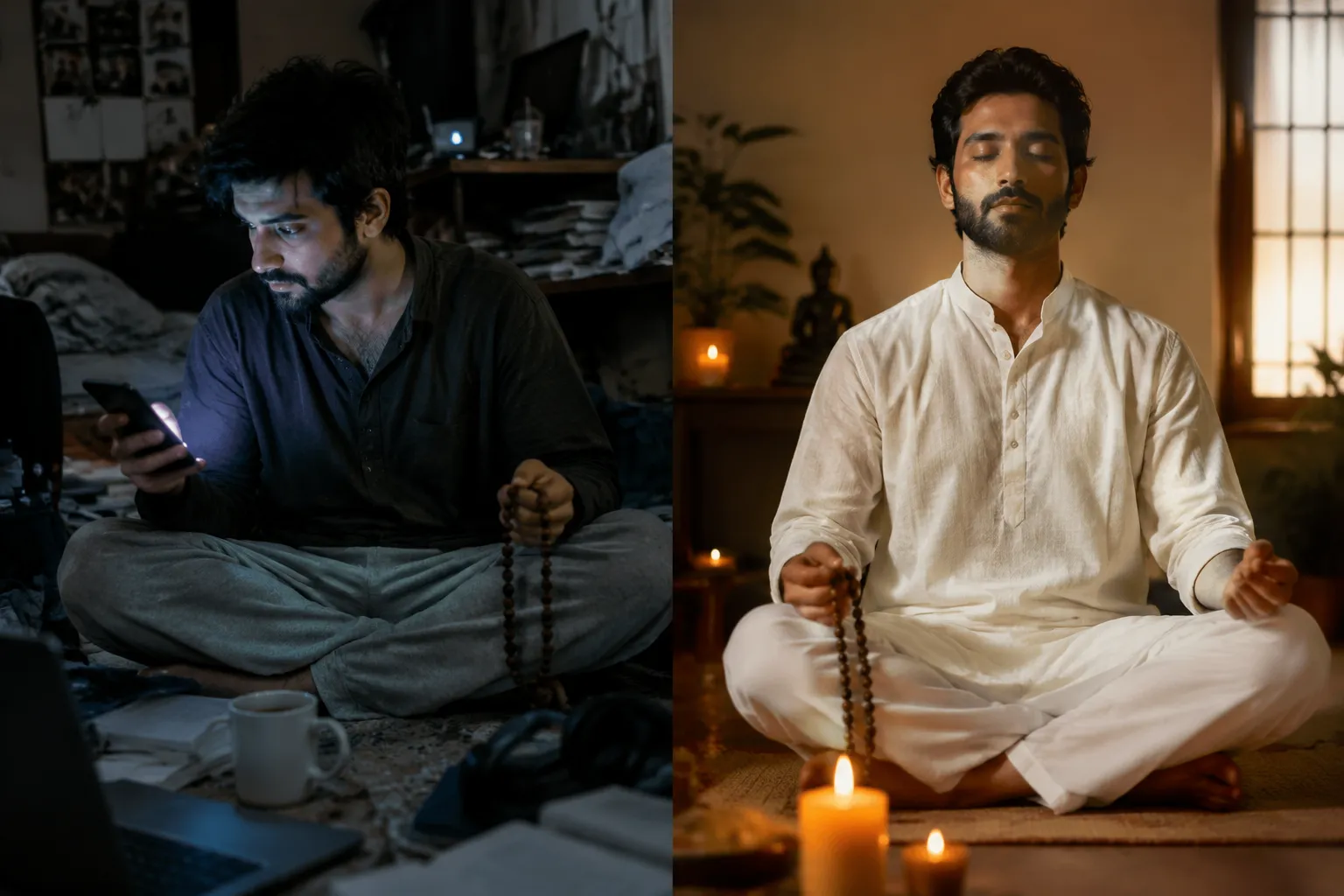
Ask honestly: is the body chanting while the mind is somewhere else, planning dinner, replaying a conversation, scrolling through worry? Gradually noticing this wandering and returning attention to the sound, meaning, and feeling of the mantra is itself the practice. This is not a failure to be fixed once and for all; it is a repeated act of return that slowly strengthens one-pointed attention.
Edge case: A beginner who chants only 20 minutes with full attention often progresses faster than someone who chants two hours while mentally absent. Depth, not duration alone, drives the shift traditions describe as siddhi.
Faith, Devotion, and Mantra Practice
Faith and devotion, or bhakti, shape mantra practice by turning the mantra from a sound to be manipulated into an expression of relationship with a chosen deity or spiritual principle. This distinction separates spiritual practice from a purely transactional mindset.
A transactional approach sounds like: “I chant this, therefore I must receive that.” A devotional approach instead treats the mantra as an offering, a form of remembrance, or an act of surrender. Many practitioners find that devotion sustains practice through the inevitable stretches when motivation dips or results feel distant, something a purely outcome-focused mindset struggles to survive.
What’s the Difference Between Mantra Chanting and Regular Meditation?
Mantra chanting uses a specific sound, phrase, or syllable as the primary object of attention, while general meditation may focus on the breath, bodily sensation, or open awareness without any fixed verbal anchor. Both aim at concentration and inner stillness, but mantra practice adds the dimensions of sound, meaning, and often devotional relationship to a deity or principle.
Is Mantra Meditation Better Than Other Types of Meditation?
Mantra meditation is not inherently “better,” but it offers a concrete, repeatable anchor that some practitioners find easier to return to than breath or open awareness alone. Someone who struggles to settle the mind with silent meditation may find a mantra’s rhythm and sound more graspable. Choose mantra meditation if you want a structured, tradition-rooted practice with a devotional dimension; choose open awareness meditation if you prefer a technique without religious or verbal content.
The Importance of Discipline
Discipline determines whether mantra practice produces lasting change, and sustained daily practice typically matters more than occasional intense sessions. Traditional purashcharana guidance illustrates this well: it specifies vegetarian diet, often one restrained meal per day, avoidance of intoxicants, celibacy for the duration of intensive practice, near-complete silence, and a fixed dedicated seat, all in service of consistency rather than dramatic effort, as outlined in classical siddhi manuals.
Key elements of discipline include:
- Regularity, showing up daily, even briefly, rather than sporadically for long stretches
- Patience, accepting that inner change unfolds gradually
- Moderation, avoiding extremes in diet, sleep, or exertion
- Ethical conduct, aligning daily behavior with the spirit of the practice
- Attention, returning focus to the mantra each time it drifts
- Respect for the practice, treating the mantra and the practice space with care, not casualness
Central message: Mantra practice deepens through consistency, not impatience. A modest daily commitment kept for a year outperforms an intense burst abandoned after two weeks.
Best Mantras for Beginners in Spiritual Practice
Beginners are generally encouraged to start with widely accepted, non-initiatory mantras rather than esoteric tantric bija mantras. Mantras to Ganesha, Guru, Shiva, Vishnu, the Mahamrityunjaya mantra, and the Gayatri mantra are commonly recommended starting points, chanted around 108 times with correct pronunciation, a clean space, and sincere devotional intention, even without formal initiation.
These mantras work well for beginners because they are broadly documented, widely taught, and generally considered safe for self-practice, while still offering genuine devotional and contemplative depth. For readers exploring specific mantras tied to particular life areas, browsing a dedicated collection of traditional mantras and chants can help identify one aligned with personal intention before committing to daily practice.
7 Common Mistakes in Mantra Chanting
Avoiding these mistakes preserves both the integrity and the depth of a mantra practice:
| Mistake | Why It Matters |
|---|---|
| Changing mantras constantly | Prevents the sustained repetition needed for deeper familiarity |
| Ignoring pronunciation | Weakens traditional structure and intended effect |
| Chanting only for a quick result | Sets up disappointment and a transactional mindset |
| Focusing exclusively on numerical count | Misses the concentration and devotion the count is meant to support |
| Practicing inconsistently | Breaks the cumulative discipline that builds over time |
| Treating every unusual sensation as a spiritual sign | Encourages misinterpretation over discernment |
| Attempting advanced initiatory practices without guidance | Risks ineffective or destabilizing practice |
Are Visions, Vibrations, or Unusual Experiences Signs of Siddhi?
No, unusual sensations during chanting are not automatic proof of mantra siddhi. Some practitioners report vivid dreams, tingling, emotional shifts, or heightened concentration during meditation or chanting, but these are subjective experiences that can arise from many causes, including simple relaxation, fatigue, or suggestion.
Discernment matters more than excitement here. A calm, curious attitude toward unusual experiences, neither dismissing them nor treating every one as supernatural confirmation, reflects a mature approach. If such experiences become distressing or confusing, guidance from an experienced teacher is more useful than self-diagnosis.
What Changes When Mantra Practice Becomes Deeper?
At the beginning, most practitioners ask, “What can this mantra give me?” With sustained, attentive practice, the question often shifts toward, “What is this mantra changing within me?”
This shift marks the spiritual heart of mantra practice. Possible themes that traditions associate with deeper practice include:
- Greater self-awareness
- Increased concentration
- Deeper devotion
- Emotional steadiness
- Reduced attachment to outcomes
- More sustained contemplation
These are presented as traditional aims and possible experiences, not guaranteed or scientifically verified outcomes. Progress looks different for each practitioner and each mantra.
How Long Does It Take to Achieve Mantra Siddhi?
There is no fixed universal timeline, though traditional purashcharana structures often use periods of 40 days, 90 days, six months, or one year as benchmarks for completing prescribed counts. These durations mark the completion of a structured practice, not a guaranteed moment when siddhi is “achieved.”
Some practitioners report a felt shift in concentration or devotion within a 40-day cycle; others describe gradual change unfolding across years of consistent practice. The honest answer is that duration depends on the mantra, the tradition, the practitioner’s consistency, and factors that cannot be reduced to a single number.
Can Women Practice Mantra Siddhi Like Men?
Yes, in most contemporary traditions and teaching lineages, sincere practitioners of any gender can pursue mantra siddhi through the same core elements: correct pronunciation, consistency, concentration, devotion, and appropriate guidance. Historically, some specific ritual restrictions existed within certain schools, but mainstream mantra practice today is widely taught and practiced across genders without a separate standard for outcome or sincerity.
Can You Chant Mantras at Any Time of Day?
Yes, mantras can generally be chanted at any time of day, though many traditions favor Brahma Muhurta (roughly 4 to 6 AM) or a consistent evening slot for deeper practice. What matters more than the specific hour is repeating the same time daily so the practice becomes a stable habit rather than an occasional activity.
For readers who want to align practice with broader auspicious timing, checking a daily panchang for shubh muhurat and rahu kaal can offer additional traditional context, though it is not a requirement for effective practice.
Mantra Chanting Not Working? What Might You Be Doing Wrong
If mantra chanting feels unproductive, the most common causes are inconsistent practice, mechanical repetition without attention, incorrect pronunciation, or unrealistic expectations of quick results. Reviewing the basics usually resolves the issue faster than switching mantras repeatedly.
Quick troubleshooting checklist:
- Are you practicing daily, or only when convenient?
- Is your mind present during chanting, or wandering most of the time?
- Have you verified pronunciation against a reliable traditional source?
- Are you expecting a specific outcome within an unrealistic timeframe?
- Have you changed mantras multiple times in recent months?
Addressing these basics before assuming the mantra “isn’t working” resolves most stalled practices.
Do You Need Extreme Practices to Attain Mantra Siddhi?
No, spiritual seriousness does not require extreme or dangerous practices. Self-harm, dangerous fasting, sleep deprivation, intoxication, physical abuse, or risky occult experiments are not required components of genuine mantra siddhi in mainstream traditions, and several precaution-focused texts explicitly warn against unsafe practices, as outlined in guidance on mantra sadhana precautions.
The deepest spiritual discipline is mastery of attention and conduct, not the destruction of the body. A practitioner who sits calmly, breathes steadily, and returns attention to the mantra hundreds of times demonstrates far more discipline than one who pursues dramatic physical extremes for a shortcut that traditions do not actually promise.
A Simple Daily Mantra Practice Framework
A safe, general framework for daily mantra practice follows seven steps: prepare, sit steadily, set intention, become quiet, chant, observe, conclude.
- Prepare, clean the space, sit at the same time and place each day
- Sit steadily, settle into a stable posture with a straight spine
- Set intention, silently state why you are practicing today
- Become quiet, take a few slow breaths to settle the mind
- Chant, repeat the mantra with attention to sound and meaning, using a mala if helpful
- Observe, notice, without judgment, where the mind wandered and where it stayed
- Conclude, sit quietly for a moment before returning to daily activity
This framework intentionally avoids specialized ritual instructions for restricted or initiation-based practices, which should be learned directly from a qualified teacher.
The Deeper Meaning of Mantra Siddhi
The real transformation mantra practice offers is not necessarily “I acquired a supernatural power.” It is closer to: “The mantra gradually changed the way I relate to my own mind, desires, fears, and awareness.”
This framing respects traditional beliefs about siddhis as extraordinary attainments while grounding the everyday practice of most seekers in something achievable and verifiable through their own experience: steadier attention, calmer emotional responses, and a more devotional relationship with life. Traditions differ on how far this can extend, and readers exploring related remedial or ritual practices may also find value in broader Vedic mantra and ritual resources or a wider collection of Vedic upay practices for context on how mantra work fits into larger spiritual and remedial traditions.
Final Spiritual Message
Do not merely count the mantra. Listen to it. Understand it. Feel its meaning. Return to it with discipline. And observe what changes within.
Siddhi begins where mechanical repetition ends, not when the tongue merely repeats the mantra, but when the mantra begins to transform the consciousness of the one who chants it.
Conclusion
Mantra siddhi is best understood as a disciplined, gradual alignment between a practitioner’s attention, devotion, and daily conduct, not a shortcut to supernatural power. Correct pronunciation, sincere intention, consistent timing, steady concentration, and appropriate guidance for advanced mantras all shape whether a practice deepens or stalls at mechanical repetition. Beginners can start safely with well-known, widely taught mantras chanted with attention and devotion, while esoteric or initiation-based practices deserve guidance from a qualified teacher rather than random online instructions.
Next steps: Choose one appropriate mantra, commit to a fixed daily time and space, chant with attention rather than speed, and revisit your intention weekly rather than chasing a specific outcome. Consistency, sustained over months, does more for genuine spiritual growth than any single dramatic session ever could.
अपनी व्यक्तिगत ज्योतिषीय सेवा बुक करें https://link.jyotishdev.com/profile
Jyotish Dev brings authentic, human astrologers-analyzed Vedic astrology from Bhubaneswar to the world. We decode your Kundali to provide profound life clarity globally.
