

Jyotish Dev is a trusted center for authentic Vedic astrology. Operating globally from Bhubaneswar, our team of expert astrologers provides precise Kundali analysis, future predictions, and actionable remedies to help seekers navigate life’s journey with clarity and confidence.
Kundali Matching vs. Western Compatibility Tests: Which Works Better for Relationship Harmony in 2026?
 Last updated: August 23, 2026
Quick Answer: For couples considering marriage in 2026, Kundali matching offers a highly detailed, tradition-focused Vedic astrology assessment centered on compatibility for long-term marital harmony, while Western compatibility tests range from broad Sun-sign comparisons to more comprehensive synastry analyses that typically focus on general relationship dynamics. Both systems offer reflective insights rather than scientifically proven predictions of success.
Key Takeaways:
- Kundali matching (Vedic astrology) uses precise birth details to evaluate compatibility through the 36-point Ashtakoot Guna Milan system and broader chart analysis, with a strong emphasis on marriage.
- Western compatibility often starts with basic Sun-sign comparisons, but can extend to full synastry, which analyzes entire birth charts for broader relationship dynamics.
- The Ashtakoot Guna Milan system assesses eight specific compatibility factors, traditionally aiming for a score above 18-20 for a favorable match.
- Vedic astrology prioritizes the Moon sign and Nakshatra for emotional, mental, and temperamental compatibility in marriage.
- Simple Western Sun-sign tests are far less detailed than a complete Kundali analysis or a full Western synastry reading.
- A Guna score alone is insufficient for a comprehensive Kundali matching for marriage; deeper analysis of planetary positions, doshas, and house lords is essential.
- Neither Kundali matching nor Western compatibility tests are scientifically proven predictors of marital success; they are interpretative frameworks.
- Ultimately, effective communication, mutual respect, shared values, and emotional maturity are crucial for relationship success, regardless of astrological assessments.
- Couples should use astrological assessments as a tool for self-reflection and understanding, not as the sole determinant for major life decisions like marriage.
What Is Kundali Matching and How Does It Work?
Kundali matching, also known as horoscope matching or Vedic astrology marriage compatibility, is a traditional system predominantly used in India to assess the compatibility between a prospective bride and groom before marriage. It works by analyzing the birth charts (Kundalis) of both individuals, generated from their precise birth date, time, and place, to evaluate various aspects of their personalities, temperaments, and destinies to predict the potential harmony and longevity of their marital union. The primary methodology involves the Ashtakoot Guna Milan system, which translates to the “eightfold matching of qualities.”
The Ashtakoot Guna Milan: A 36-Point Framework
The Ashtakoot Guna Milan is a cornerstone of Vedic marriage compatibility, evaluating 8 specific parameters, each assigned a certain number of “Gunas” or points, totaling 36. A higher Guna score (traditionally above 18-20) is considered more favorable, though a full analysis goes beyond this score alone.
Here are the eight Kootas (parameters) evaluated:
- Varna (1 point): Matches the spiritual or ego compatibility, assessing the work and nature of the individuals.
- Vashya (2 points): Evaluates mutual attraction and control, categorizing individuals into five types (manav, vanchar, chatushpad, jalchar, keet).
- Tara (3 points): Assesses destiny and health compatibility based on the birth Nakshatra (lunar mansion).
- Yoni (4 points): Measures sexual and biological compatibility, associating individuals with specific animal types.
- Graha Maitri (5 points): Determines intellectual and mental compatibility, examining the friendship between the Rashi (Moon sign) lords. For a deeper understanding of planetary roles, explore the Role Of Grahas In Kundali.
- Gana (6 points): Compares temperament and behavioral compatibility, classifying individuals into Dev (divine), Manushya (human), or Rakshasa (demonic) Ganas.
- Bhakoot (7 points): Assesses the financial prosperity, family welfare, and overall compatibility by comparing the Moon signs, also detecting potential doshas (afflictions).
- Nadi (8 points): The most crucial factor, evaluating genetic and health compatibility, particularly concerning progeny and hereditary diseases. It is divided into Aadi, Madhya, and Antya.
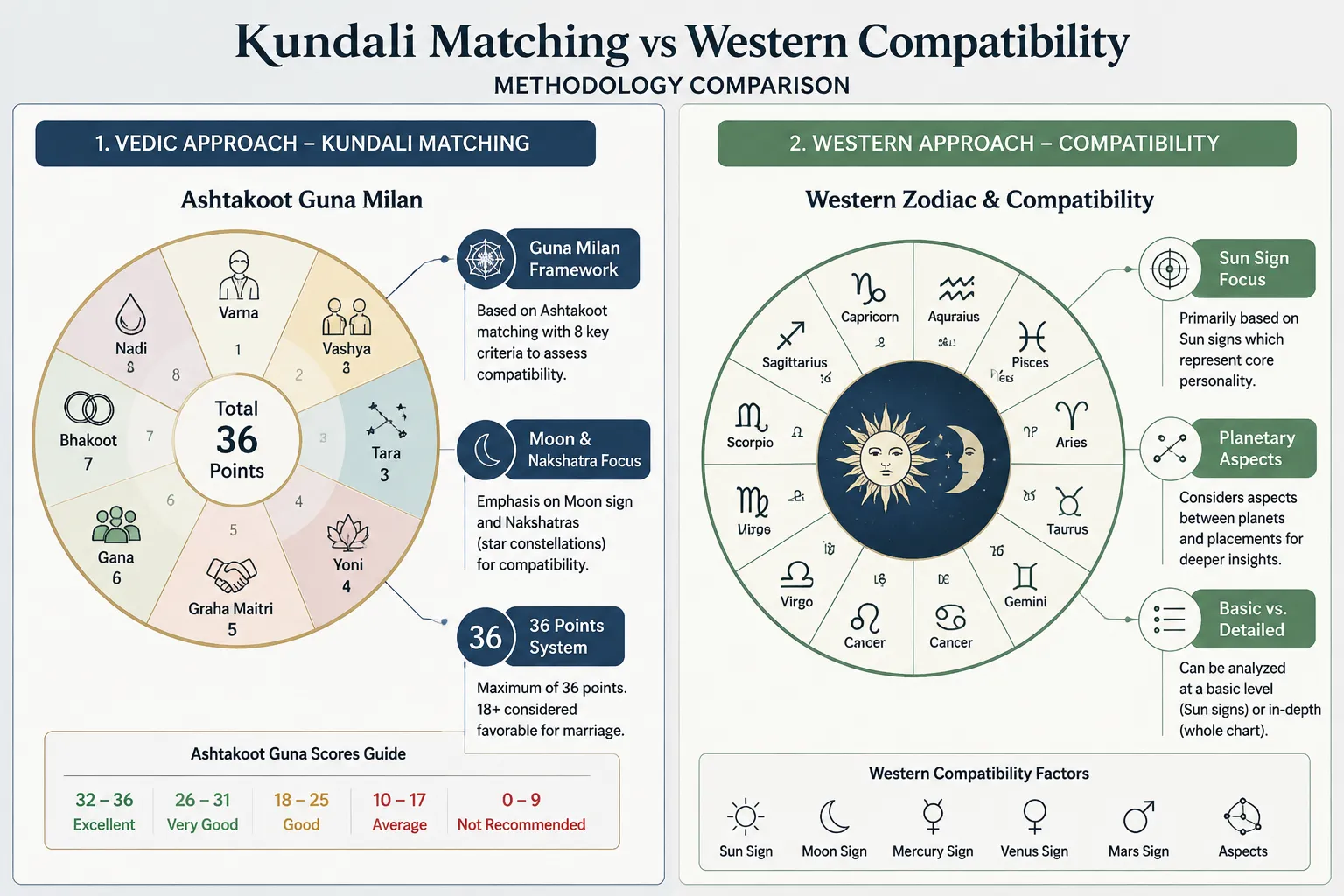
Guna Milan attempts to evaluate a wide range of factors for a long-term relationship. It encompasses temperament, communication styles, traditional health considerations, emotional compatibility, and the overall potential for enduring harmony within the marriage. This intricate system provides a multi-faceted view of potential marital dynamics.
What Are Western Compatibility Tests?
Western compatibility tests generally refer to various methods of assessing relationship potential using Western astrological principles. The most popular and widely accessible forms typically compare Sun signs, offering quick, generalized insights into personality traits and potential interactions. However, a more detailed and sophisticated approach in Western astrology involves comparing entire birth charts, known as synastry.
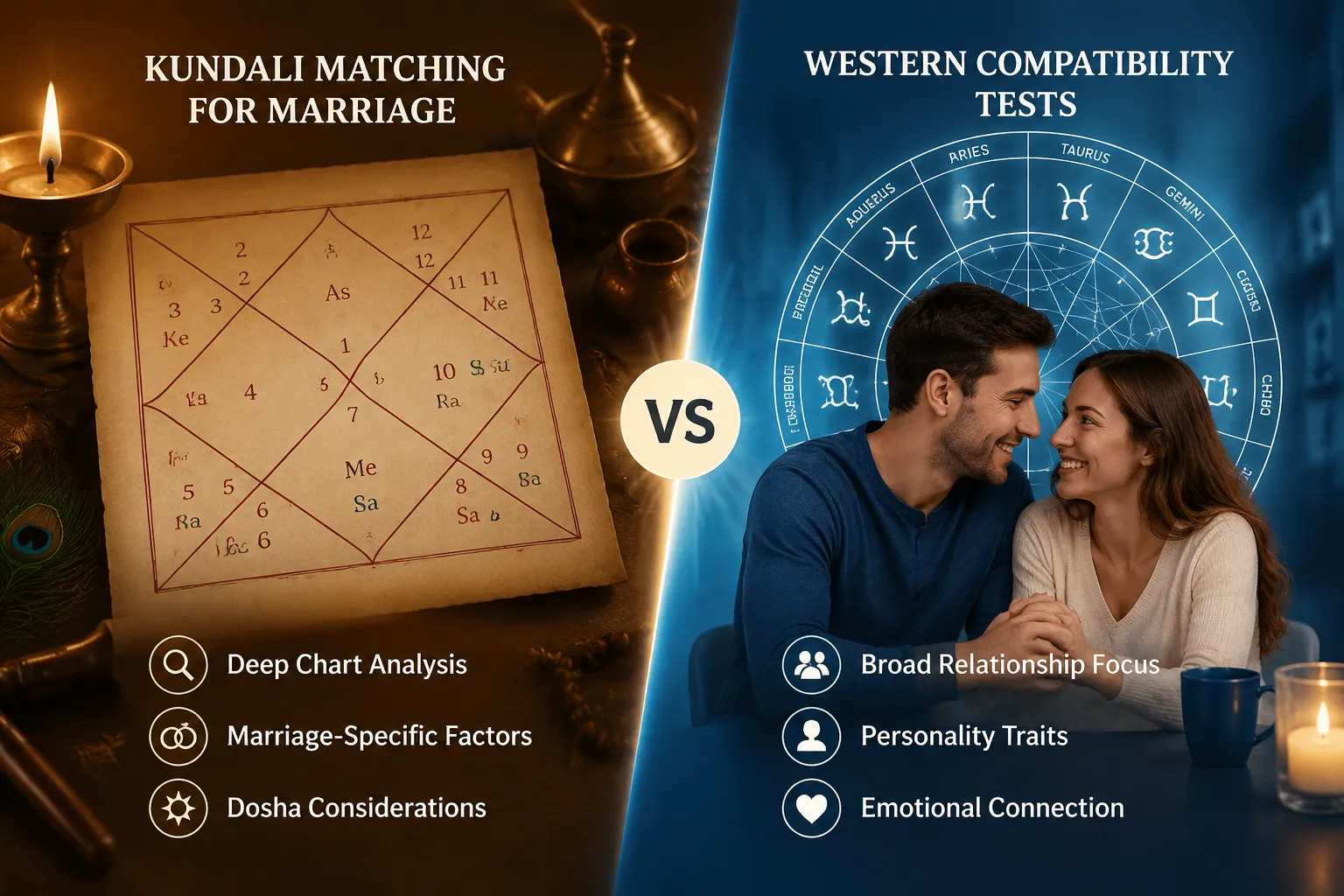
Popular Western astrology compatibility content often focuses on broad generalizations based on Sun signs. For example, a “fire sign” like Aries might be deemed compatible with another fire sign or an “air sign” like Libra. These tests are ubiquitous in magazines and online quizzes, providing lighthearted entertainment and initial conversation starters rather than deep analysis.
A crucial distinction exists between these popular Sun-sign comparisons and full Western synastry. While Sun-sign compatibility might only require birth dates, synastry demands accurate birth dates, times, and places for both individuals. This allows an astrologer to cast complete birth charts, including the positions of the Sun, Moon, Mercury, Venus, Mars, Jupiter, Saturn, Uranus, Neptune, Pluto, and the Ascendant (rising sign), as well as the houses and aspects between planets. This comprehensive approach delves much deeper into psychological patterns, emotional needs (Moon), communication styles (Mercury), romantic inclinations (Venus), and assertive drives (Mars) to assess the complex dynamics of a relationship.
Kundali Matching vs. Western Compatibility: Which System Offers More Insight?
When comparing Kundali matching vs. Western compatibility, it’s essential to understand their distinct methodologies and primary focuses. Both aim to shed light on relationship dynamics, but they do so through different lenses and levels of detail.
| Factor | Vedic Kundali Matching | Western Compatibility |
|---|---|---|
| Primary approach | Ashtakoot + broader chart analysis (Dashas, Doshas) | Sun-sign tests or full synastry |
| Birth information | Date, time, and place are crucial for accuracy | Basic tests may need only birth dates; full synastry needs date, time, and place |
| Marriage focus | Strong traditional focus on marital harmony and progeny | Usually broader relationship focus; often used for dating as well |
| Emotional compatibility | Moon/Nakshatra-based analysis, mental harmony | Moon and other planetary placements, psychological needs |
| Long-term factors | Guna Milan, Manglik Dosha, Dashas, house lords, Navamsa | Synastry (planetary aspects, house overlays), composite chart |
| Personalization | High with accurate birth data and expert interpretation | Varies from basic Sun-sign generalized traits to highly personalized synastry |
Western Sun-sign tests provide a very superficial understanding compared to the intricate calculations of Kundali matching or even full Western synastry. While Sun signs offer a broad brushstroke of core personality, they miss the nuances of emotional nature, communication, and long-term potential that other planetary placements and house analyses provide. For comprehensive insights into relationships, especially those leading to marriage, both Vedic Kundali matching and full Western synastry delve significantly deeper than simple Sun-sign comparisons.
Why Moon Sign and Nakshatra Matter in Vedic Matching
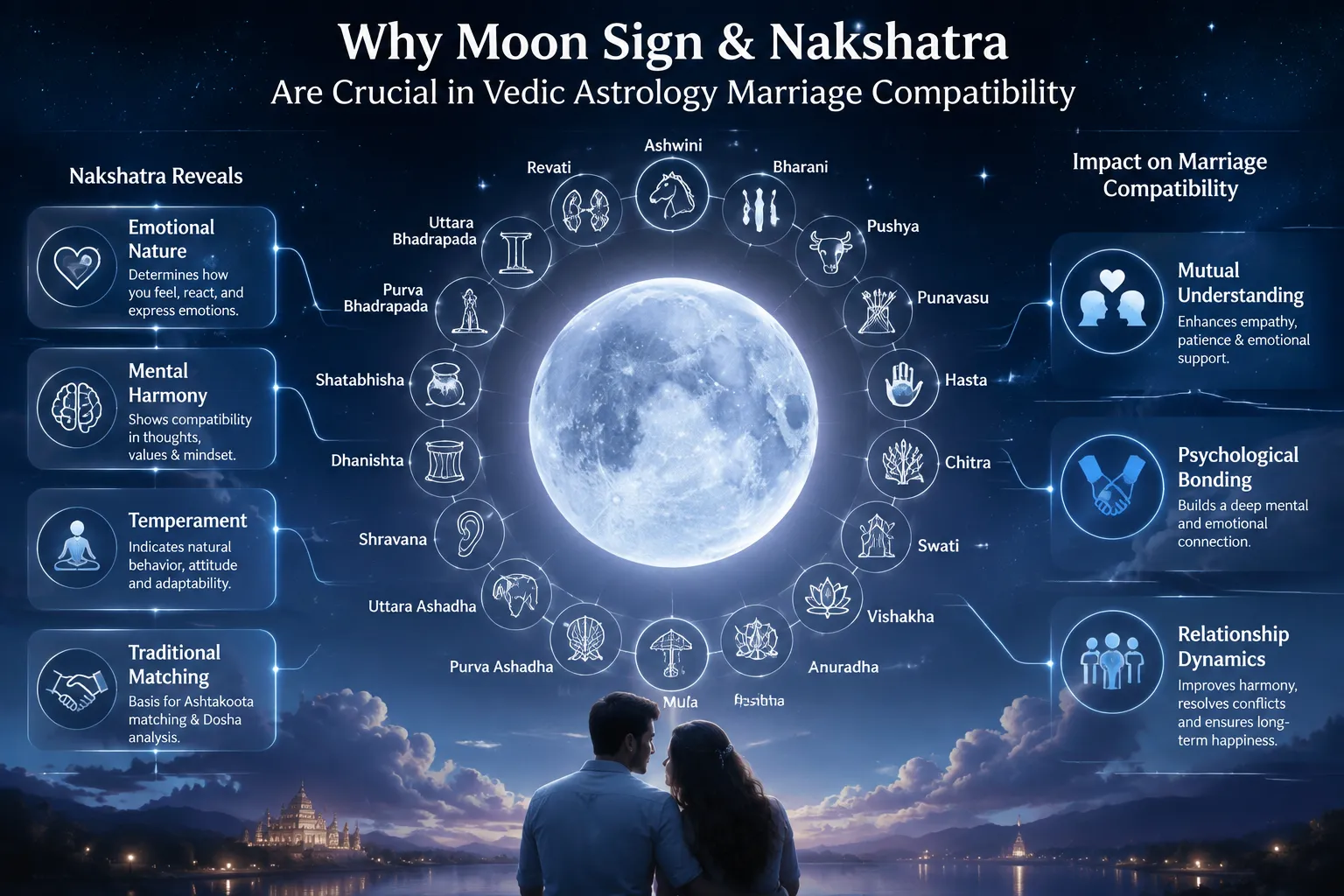
For followers of Jyotish Dev and Vedic astrology, the Moon and Nakshatra are critically important in traditional Kundali Matching because they offer profound insights into an individual’s emotional nature, mental compatibility, and core temperament. Unlike Western astrology, which often centers on the Sun sign for personality, Vedic astrology places a strong emphasis on the Moon’s position as the karaka (significator) of the mind, emotions, and inner self.
The Moon sign (the Rashi where the Moon is placed) reveals a person’s emotional responses, instinctual behaviors, and how they deal with inner feelings. A harmonious Moon sign compatibility between partners often indicates a deeper emotional connection and mutual understanding, which are foundational for a lasting marriage. The Moon is seen as the controller of the mind, and mental compatibility is paramount in Vedic tradition.
The Nakshatras, or lunar mansions, are 27 divisions of the zodiac, each spanning 13 degrees and 20 minutes, through which the Moon travels. Each Nakshatra has its own unique characteristics, ruling deity, symbol, and planetary lord. Comparing the Nakshatras of prospective partners provides incredibly detailed information about:
- Emotional Nature: How individuals express and perceive emotions.
- Mental Compatibility: The alignment of thought processes and intellectual understanding.
- Temperament: Inherent dispositions and reactions to life’s challenges.
- Traditional Role: Nakshatra-based assessments, particularly Tara, Yoni, Gana, and Nadi Kootas, form the backbone of the Ashtakoot Guna Milan system, offering insights into health, progeny, and overall well-being in marriage.
This deep dive into lunar placements ensures that the astrological assessment goes beyond superficial personality traits, addressing the fundamental emotional and psychological compatibility essential for a successful marriage. You can learn more about how to interpret your own chart in our guide on How to Read Your Kundali: A Beginner’s Step-by-Step Guide.
Which Method Is More Detailed?
A simple Western Sun-sign compatibility test is generally much less detailed than a complete Kundali analysis for marriage. Sun-sign compatibility offers a broad, generalized overview of personality traits based solely on the month of birth, often overlooking the complex interplay of other planets, houses, and specific degrees.
In contrast, a complete Kundali analysis, which includes the Ashtakoot Guna Milan and a broader chart assessment, uses the precise date, time, and place of birth to construct a unique birth chart. This chart maps the positions of all planets, the Ascendant (Lagna), and various sensitive points, allowing for a highly personalized and intricate compatibility reading. This level of detail considers multiple layers of an individual’s psychological, emotional, and physical makeup.
Similarly, a full Western synastry reading, which compares two complete birth charts, is also far more detailed than a Sun-sign test. Synastry examines the aspects (angles) between planets in both charts and how planets in one chart fall into the houses of the other, revealing specific areas of harmony, challenge, and attraction.
It is important to clarify that while both Vedic and Western full-chart analyses offer extensive detail, neither system is scientifically proven to predict relationship success with certainty. Both are astrological frameworks, rooted in ancient traditions and symbolic interpretations, rather than empirically validated relationship-prediction systems. Existing peer-reviewed overviews suggest that astrological matching should be seen as a cultural or reflective practice, not a scientific predictor [13]. Studies on large datasets for Western Sun-sign compatibility have found no evidence that astrologically “compatible” pairings have better outcomes [6, 10, 11]. Similarly, a data-driven investigation of Vedic Guna Milan scores found no statistically significant difference in scores between “successful” marriages and others [5].
Can Guna Milan Alone Decide Marriage Compatibility?
No, the traditional 36 Guna score from the Ashtakoot Guna Milan system should not be treated as the sole deciding factor for marriage compatibility in Vedic astrology. While a higher Guna score (often 18-20 or above) is considered auspicious, it provides only a preliminary assessment. A deeper, more holistic Vedic analysis is essential to understand the true potential for marital harmony. For comprehensive insights into a couple’s marital journey, exploring resources like Love & Marriage Compatibility | Jyotish Dev can be beneficial.
A comprehensive Vedic analysis for marriage considers several critical factors beyond just the Guna Milan score:
- Manglik Dosha: This is a significant affliction caused by Mars’s placement in specific houses (1st, 2nd, 4th, 7th, 8th, or 12th) in the birth chart. If one partner has Manglik Dosha and the other does not, it’s traditionally believed to create challenges, though remedies and other planetary placements can mitigate its effects.
- 7th House and its Lord: The 7th house in a birth chart governs marriage, partnerships, and relationships. Its strength, the planets residing within it, and the condition of its lord are crucial indicators of marital prospects and the nature of the spouse.
- Venus and Jupiter: Venus is the karaka (significator) of love, romance, marriage, and marital happiness. Jupiter signifies wisdom, fortune, and children. The strength and placement of these planets in both charts, along with their aspects, are vital for assessing love, prosperity, and progeny.
- Moon and Nakshatra: As discussed, the Moon signifies emotional and mental compatibility, while Nakshatras offer detailed insights into temperament and inherent traits. Their combined influence is paramount for understanding the emotional bond.
- Navamsa (D9) Chart: This divisional chart (D9) is specifically used for marriage and spiritual growth. A strong Navamsa chart often indicates a successful and fulfilling marriage, even if the main birth chart (D1) shows some challenges. The Navamsa chart reveals the deeper potential and spiritual connection between partners.
- Dashas and Planetary Periods: The current and future planetary periods (Dashas) for both individuals are examined to understand the timing of events and challenges they might face. Astrologers assess if favorable Dashas align during crucial marital periods.
- Relevant Aspects and Planetary Strength: The overall strength of various planets, benefic or malefic aspects between planets in both charts, and their placements in houses are analyzed to provide a complete picture of strengths and weaknesses in the relationship.
A lower Guna score does not automatically mean a relationship will fail, nor does a high score guarantee a successful marriage. Real-world dynamics, personal effort, communication, and mutual understanding play significant roles. For example, a 2020 survey of 19 Indian couples found a “high correlation” between Vedic matchmaking and post-marriage psychological adjustment, but the authors acknowledged the tiny sample size and called for more rigorous research [1, 4]. Other studies, like one on Vedic Guna Milan, found no statistically significant difference in compatibility scores between “successful” marriages and others, challenging the idea that higher scores directly predict bliss [5].
How Accurate Is Kundali Matching Compared to Western Astrology?
Assessing the “accuracy” of Kundali matching compared to Western astrology is complex, as both are interpretative astrological systems rather than scientifically validated predictors of relationship success. Neither system offers empirical proof that it can definitively predict marital outcomes.
However, when comparing the depth of analysis:
- Kundali Matching (Vedic Astrology): Offers a highly detailed and nuanced assessment, especially for marriage. It considers not just planetary positions but also Nakshatras, divisional charts like Navamsa, doshas (like Manglik), and planetary periods (Dashas). This allows for a multi-layered evaluation of emotional, physical, mental, and spiritual compatibility, with a specific focus on the longevity and harmony of a marital union.
- Western Astrology (Full Synastry): Also provides a detailed analysis when a full synastry chart is performed. It examines how planets in one person’s chart interact with those in another’s, looking at aspects and house overlays. This reveals psychological dynamics, areas of attraction, and potential challenges. However, popular Western Sun-sign compatibility tests are far less accurate or detailed than full synastry or Kundali matching.
Current research highlights that both systems should be considered cultural or reflective practices. Large-scale Western Sun-sign research, including studies on millions of marriages, consistently finds no evidence that astrologically “compatible” pairings lead to more successful marriages or lower divorce rates [6, 10, 11]. Similarly, while a widely reported study on Kundali matching found higher happiness rates for matched couples, the observational design makes it vulnerable to selection bias, meaning causation cannot be inferred [2]. A meta-analysis on astrology and relationship happiness found only modest correlations with self-reported happiness for some Vedic indicators, stressing that the signal is small and intertwined with psychological factors [8].
Therefore, both systems provide frameworks for self-reflection and understanding potential relationship dynamics, but neither can be definitively called “accurate” in a scientific sense for predicting relationship success.
What’s the Difference Between Vedic and Western Zodiac Compatibility?
The fundamental differences between Vedic and Western zodiac compatibility lie in their astronomical basis, chart calculation methods, philosophical underpinnings, and primary focus for compatibility assessments. These distinctions lead to different zodiac signs, planetary interpretations, and compatibility criteria.
-
Ayanamsa (Zodiac System):
- Vedic Astrology (Jyotish): Uses the sidereal zodiac, which is fixed against the actual constellations in the sky. It accounts for the precession of the equinoxes through an adjustment called Ayanamsa. This means that the zodiac signs in Vedic astrology are generally offset by about 23-24 degrees compared to Western astrology.
- Western Astrology: Uses the tropical zodiac, which is fixed to the seasons and the Earth’s relationship to the Sun (e.g., Aries always starts at the spring equinox). It does not account for the precession of the equinoxes.
-
Planet Interpretations: While both systems use the same planets, their significations and emphasis can differ. Vedic astrology places a strong emphasis on the Moon, Nakshatras, and specific benefic/malefic natures of planets, along with their rulership over houses and specific Dashas (planetary periods).
-
Compatibility Methodology:
- Vedic Compatibility (Kundali Matching): Primarily focuses on Ashtakoot Guna Milan, a 36-point system based on the Moon signs and Nakshatras. It also heavily considers doshas (afflictions like Manglik Dosha), the condition of the 7th house and its lord, and divisional charts like Navamsa, with a strong emphasis on marriage longevity and progeny.
- Western Compatibility (Synastry): Primarily focuses on planetary aspects between two charts (e.g., Sun conjunct Moon, Venus square Mars) and house overlays (where one person’s planets fall into the houses of the other). It provides insights into psychological dynamics, attraction, and areas of challenge, often with a broader application to any significant relationship, not just marriage.
-
Cultural and Philosophical Context:
- Vedic Astrology: Deeply rooted in Hindu philosophy and tradition, often viewed as a tool for understanding karma, dharma, and life’s purpose, with compatibility for marriage being a major application.
- Western Astrology: Has roots in Hellenistic and Babylonian traditions, often used for personality analysis, understanding life cycles, and general relationship dynamics, sometimes leaning more towards psychological insights.
These differences mean that a person might have a different zodiac sign in Vedic astrology than in Western astrology (e.g., a Western Leo might be a Vedic Cancer). Consequently, compatibility assessments based on these systems will also yield distinct results.
Can Western Zodiac Signs Predict Marriage Compatibility?
Western zodiac signs, particularly Sun signs, can offer very general insights into personality types that might suggest broad compatibility, but they are generally considered insufficient for predicting the complex nuances of marriage compatibility. Relying solely on Sun-sign compatibility for a major life decision like marriage is widely viewed as a significant oversimplification.
Popular Sun-sign compatibility content often provides generalized pairings, such as “fire signs get along with air signs.” While these can be fun and offer a superficial understanding of initial attraction or general interaction styles, they lack the depth required for a long-term commitment. A person’s Sun sign represents their core ego and identity, but marriage involves much more, including emotional needs (Moon), communication patterns (Mercury), romantic style (Venus), and shared values (Jupiter, Saturn, etc.).
Numerous studies and re-analyses have investigated the claim that Sun-sign compatibility predicts marital success. A re-analysis of 27 million couples and another study titled “Ten Million Marriages” found no evidence that astrologically “compatible” Sun-sign pairings are overrepresented among marriages or have lower divorce rates than “incompatible” pairings [6, 10, 11]. Another study examining over 65,000 marital unions from 1968-2001 reported that differences in divorce risk across supposedly favorable, neutral, and unfavorable Sun-sign combinations are statistically trivial and inconsistent, explicitly rejecting the validity of advice from commercial Western compatibility sites [6, 7].
Therefore, while Sun-sign compatibility might offer interesting discussion points, it does not provide a reliable or scientifically supported basis for predicting the success or failure of a marriage. For a more detailed Western astrological perspective, full synastry is necessary, though even then, astrological frameworks are best seen as tools for reflection rather than definitive predictions.
How Much Does Kundali Matching Cost?
The cost of Kundali matching varies widely depending on the astrologer’s experience, reputation, the depth of the analysis, and the region. In 2026, basic Kundali matching services might range from free online tools that provide automated Guna Milan scores to professional consultations that can cost a significant amount.
- Free Online Tools: Many websites offer free automated Kundali matching or Guna Milan scores. These tools typically require birth details and instantly generate a score. However, they lack the nuanced interpretation and personalized advice of a human astrologer.
- Basic Consultations: For a more thorough Guna Milan and preliminary chart analysis by a professional astrologer, costs might range from ₹500 to ₹3,000 (approximately $6-$36 USD) in India, or higher in Western countries.
- Comprehensive Consultations: A detailed Kundali matching for marriage, which includes an in-depth analysis of Manglik Dosha, planetary positions, Navamsa charts, Dashas, and personalized remedies or guidance, can cost anywhere from ₹3,000 to ₹15,000 (approximately $36-$180 USD) or more. Highly experienced and renowned astrologers, particularly those offering follow-up sessions or complex problem-solving, may charge even higher fees.
Factors influencing cost include:
- Astrologer’s expertise: Senior astrologers with decades of experience typically charge more.
- Report detail: The length and comprehensiveness of the written report or verbal consultation.
- Remedies and solutions: If specific astrological remedies (e.g., for doshas) are suggested, they might be part of a higher-tier package.
- Location: Astrologers in major metropolitan areas or those serving an international clientele may have higher rates.
When seeking Kundali matching, it’s advisable to research astrologers, read reviews, and clarify the scope of the service and associated costs beforehand.
What Happens if Kundali Doesn’t Match for Marriage?
If a Kundali doesn’t match for marriage, particularly if the Ashtakoot Guna Milan score is low (below the traditionally accepted threshold of 18-20 out of 36) or significant doshas like a severe Manglik Dosha are present, it typically suggests potential challenges or disharmony in the marital relationship according to Vedic astrology. However, a “no match” does not automatically mean the marriage is impossible or doomed, as a skilled astrologer will perform a deeper analysis to understand the complete picture.
Here’s what usually happens:
- Further Analysis: A good astrologer will not stop at the Guna score. They will delve into other critical factors of both charts, such as:
- Strength of the 7th House: Even with a low Guna score, if the 7th house (of marriage) and its lord are strong and well-placed in both charts, it can mitigate some negative influences.
- Planetary Support: Benefic planets in key houses or strong harmonious aspects between Venus and Jupiter (for love and prosperity) can offer support.
- Dosha Cancellation: Many doshas, including Manglik Dosha, have specific cancellation rules or remedies. For example, if both partners have Manglik Dosha, it can cancel each other out.
- Navamsa Chart: The D9 chart for marriage might reveal a stronger underlying compatibility that the D1 chart or Guna Milan didn’t initially show.
- Remedies and Solutions: Astrologers may suggest specific remedies (Pujas, gemstone recommendations, charitable acts, fasting) to mitigate adverse planetary influences or doshas.
- Counseling and Guidance: Beyond astrological remedies, practical advice might be offered regarding communication, understanding each other’s nature, and working through potential challenges identified in the charts.
- Personal Choice: Ultimately, the decision to marry rests with the individuals and their families. While astrological guidance is highly valued in traditional contexts, many couples choose to proceed with marriage despite a less-than-ideal Kundali match, relying on mutual love, understanding, and commitment.
It is crucial for couples and families to remember that astrology offers a perspective, not an absolute decree. A comprehensive astrological reading from a trusted expert provides insights, but conscious effort, strong communication, and mutual respect remain paramount for a successful marriage, irrespective of the Kundali match. Further information can be found on Marriage Timing & Relationship Guidance | Jyotish Dev.
Is Kundali Matching Scientifically Proven?
No, Kundali matching, like other forms of astrology, is not scientifically proven to predict marital success or relationship outcomes. Scientific studies and peer-reviewed research consistently classify astrology as a pseudoscience, meaning it lacks empirical evidence and testable hypotheses that can be replicated under scientific conditions.
Several points underscore this:
- Lack of Empirical Evidence: There is no universally accepted scientific study that has conclusively demonstrated a direct, causal link between astrological compatibility (either Vedic or Western) and observable marital happiness, stability, or divorce rates.
- Observational Studies: While some studies, such as a recent widely reported study from Banaras Hindu University, found that matched couples reported higher happiness (63% happy vs. 37% for unmatched couples), such findings are often observational and prone to selection bias [2]. This means families who choose Kundali matching may systematically differ in other ways (e.g., cultural background, commitment to tradition) from those who do not, making it difficult to attribute happiness solely to the matching process.
- Small Sample Sizes: Some studies, like a 2020 survey of 19 Indian couples, reported a “high correlation” between Vedic matchmaking and psychological adjustment post-marriage, but explicitly noted the “tiny sample size” and the need for more rigorous research before claiming factual predictability [1, 4].
- Inconsistent Findings: A data-driven investigation of Vedic Guna Milan scores found no statistically significant difference in compatibility scores between “successful” marriages and others, challenging the common belief that higher scores predict marital bliss [5]. Similarly, large-scale studies on Western Sun-sign compatibility have found no evidence supporting their predictive power [6, 10, 11].
- Correlation vs. Causation: Any perceived correlations between astrological compatibility and relationship outcomes are often due to confounding factors, self-fulfilling prophecies (believing in the prediction), or selection bias, rather than a direct astrological influence.
Contemporary research on relationships highlights that robust predictors of long-term outcomes include psychological traits, communication patterns, conflict-management skills, and socioeconomic conditions [6, 11, 13]. Astrological systems, therefore, are best understood as cultural or reflective tools that can offer psychological insights or frameworks for self-understanding, rather than definitive scientific predictors of future success.
Who Should Use Kundali Matching vs. Western Compatibility Tests?
The choice between Kundali matching and Western compatibility tests depends largely on a couple’s cultural background, personal beliefs, the depth of analysis they seek, and the purpose of the assessment.
-
Choose Kundali Matching if:
- You are from a traditional Indian background: Kundali matching is a deeply ingrained cultural and religious practice in India for arranged and love marriages.
- You seek a comprehensive marriage-specific analysis: This method is specifically designed to assess long-term marital harmony, progeny, and traditional life challenges.
- You value a detailed, multi-faceted astrological perspective: It uses precise birth data to analyze a wide array of factors (Ashtakoot Guna Milan, Doshas, Navamsa, planetary periods).
- You are open to traditional remedies: Vedic astrology often comes with suggestions for mitigating negative influences.
-
Choose Basic Western Compatibility Tests (Sun-sign based) if:
- You want a quick, general personality/relationship comparison: These are excellent for initial curiosity, light entertainment, or as conversation starters in dating.
- You are exploring general relationship dynamics: They offer broad insights into how different personality types might interact.
- You prefer a less intense, less tradition-bound approach: Sun-sign compatibility is widely accessible and culturally neutral for many.
-
Consider Full Western Synastry if:
- You want a detailed Western astrological chart comparison: This method uses full birth charts to explore psychological dynamics, emotional needs, communication styles, and karmic connections between partners.
- You are looking for insights into any serious relationship (not just marriage): Synastry can be applied to business partnerships, friendships, and family dynamics, offering a broader relationship focus.
- You prefer a psychological approach to astrology: Western astrology often focuses on understanding individual and relational psychology.
For an important decision like marriage, treat any astrological assessment as one perspective among many, complementing factors like shared values, communication, and emotional maturity.
What Are Common Mistakes People Make with Kundali Matching?
While Kundali matching can be a valuable tool for self-reflection and understanding potential relationship dynamics, several common mistakes can lead to misunderstandings or misguided decisions.
- Treating Guna Milan Score as the Sole Deciding Factor: Many people mistakenly believe that a high Guna score (e.g., 30+ out of 36) guarantees a successful marriage and a low score (e.g., under 18) means automatic failure. This is a critical error. A comprehensive Kundali matching for marriage requires a detailed analysis of other crucial factors like Manglik Dosha, the 7th house, planetary strengths, and divisional charts. A high Guna score might not account for a severe dosha, while a lower score could be mitigated by strong placements elsewhere.
- Overlooking Manglik Dosha Nuances: Simply identifying Manglik Dosha without checking for its cancellations or severity is a common mistake. There are many conditions under which Manglik Dosha is considered nullified or less impactful. A blanket rejection based solely on its presence is often an incomplete assessment.
- Ignoring Precise Birth Details: Accurate date, time, and place of birth are paramount for generating a correct Kundali. Using approximated or incorrect details leads to an inaccurate birth chart and, consequently, a flawed compatibility assessment. Even a few minutes’ difference can change the Ascendant or planetary positions, altering the entire reading.
- Not Consulting a Qualified Astrologer: Relying solely on free online tools for Kundali matching, which often only provide a basic Guna Milan score, can be misleading. These tools lack the expertise of a human astrologer who can interpret complex planetary interactions, doshas, and the subtle nuances of both charts.
- Focusing Only on Negative Aspects: Some individuals become overly fixated on perceived negative aspects or doshas, neglecting potential strengths and harmonious alignments that exist in the charts. A balanced interpretation considers both challenges and areas of support.
- Expecting a “Perfect Match”: No two individuals are perfectly compatible in every aspect. Expecting an astrological reading to produce a flawless match is unrealistic. The purpose of Kundali matching is to identify potential areas of harmony and challenge, offering insights on how to navigate the relationship.
- Ignoring Practical Compatibility: Over-reliance on astrological compatibility while neglecting real-world factors like communication, shared values, emotional maturity, financial expectations, and family dynamics is a significant mistake. Astrology is a guide, not a substitute for practical compatibility and mutual effort.
By avoiding these common pitfalls, couples can gain a more balanced and insightful perspective from Kundali matching, using it as a tool to foster understanding rather than a rigid pass/fail criterion.
Can You Get Married if Kundali Doesn’t Match?
Yes, you can absolutely get married even if your Kundali doesn’t match perfectly, or if the Guna Milan score is below the traditionally desired threshold. While Kundali matching is a significant tradition, particularly in India, it serves as guidance rather than an unchangeable decree. The decision to marry ultimately rests with the individuals involved, their families, and their mutual understanding and commitment.
Here’s why many couples proceed with marriage despite a less-than-ideal Kundali match:
- Love and Mutual Understanding: Strong emotional connection, love, and a deep understanding between partners are often considered more crucial for a successful marriage than a high Guna score.
- Comprehensive Astrological Review: A skilled astrologer can perform a more in-depth analysis beyond the initial Guna Milan. They look for planetary compensations, dosha cancellations, strength of benefic planets, and the positive aspects of the Navamsa (D9) chart, which might mitigate initial incompatibilities.
- Remedies and Poojas: Astrologers may suggest specific astrological remedies, prayers (Pujas), or charitable acts to reduce the negative impact of certain planetary positions or doshas.
- Personal Growth and Effort: Many believe that challenges indicated in the Kundali can be overcome with conscious effort, good communication, patience, and a willingness to work through difficulties together.
- Cultural Shifts: While traditional values remain strong, modern perspectives increasingly emphasize individual choice and the psychological aspects of compatibility over rigid astrological dictates.
- Practical Compatibility: Factors like shared life goals, financial stability, family acceptance, and emotional maturity are often prioritized.
Ultimately, while astrological compatibility can offer valuable insights and highlight potential areas for attention, it does not predetermine a relationship’s fate. Many successful marriages thrive despite lower Guna scores or perceived astrological hurdles, because the partners actively nurture their relationship through communication, respect, and shared commitment.
How Long Does Kundali Matching Take?
The time it takes for Kundali matching can vary significantly based on the method used, the depth of analysis required, and the astrologer’s availability.
- Free Online Tools: These provide instant results. You input the birth details, and the Guna Milan score and a basic report are generated immediately. While quick, they lack personalized interpretation.
- Basic Professional Consultation: A professional astrologer performing a basic Guna Milan and a brief overview of key compatibility points might take 30 minutes to an hour for the consultation itself, with a few days for report preparation if included.
- Comprehensive Consultation: A detailed Kundali matching for marriage, involving an in-depth analysis of both charts (D1, D9), Manglik Dosha, planetary strengths, Dashas, and personalized remedies, can take much longer. The astrologer might spend several hours analyzing the charts before the consultation. The consultation itself could range from 1 to 2 hours, and a comprehensive written report might take 1-2 weeks to prepare, depending on the astrologer’s workload.
Factors that influence the duration include:
- Astrologer’s workload: Popular astrologers may have a waiting list.
- Depth of analysis: Simple Guna Milan is quicker than a full chart synthesis.
- Client’s questions: More complex questions or concerns from the client can extend the consultation time.
- Report delivery: Whether a detailed written report is part of the service and its expected turnaround time.
It’s always best to inquire about the expected timeline when booking a Kundali matching service to manage expectations.
What if Our Western Zodiac Signs Are Incompatible but Kundali Matches?
If your Western Zodiac signs (specifically Sun signs) suggest incompatibility but your Kundali (Vedic charts) show a strong match, it indicates a nuanced situation where deeper astrological insights might outweigh superficial comparisons. This scenario is common due to the fundamental differences between Vedic and Western astrological systems.
Here’s how to interpret such a situation:
- Different Foundations: Remember that Western Sun-sign compatibility is very general, while Kundali matching is a highly detailed, marriage-specific analysis based on the sidereal zodiac and the Ashtakoot Guna Milan system. Your Western Sun sign might be different from your Vedic Sun or Moon sign (your Rashi), due to the Ayanamsa difference.
- Depth of Analysis: Kundali matching delves into multiple layers of compatibility, including emotional nature (Moon/Nakshatra), mental harmony (Graha Maitri), temperament (Gana), health (Tara, Nadi), and overall well-being (Bhakoot), across 36 points and beyond. It also considers planetary strengths, doshas, and divisional charts. A simple Western Sun-sign comparison cannot offer this depth.
- Prioritize the Deeper System: In such a case, the detailed Kundali matching likely provides a more accurate and comprehensive assessment of your potential for long-term marital harmony. The “incompatibility” suggested by Western Sun signs is likely a broad generalization that doesn’t account for the intricate planetary interactions, aspects, and house placements that a full Kundali analysis considers.
- Focus on Strengths Identified: A strong Kundali match suggests that despite initial superficial differences, there are deeper energetic and emotional harmonies that support a lasting relationship. Focus on understanding these strengths as identified by the Vedic astrologer.
- Address Western “Incompatibilities” with Communication: Any perceived challenges from Western Sun-sign “incompatibility” can be seen as areas for conscious effort and communication in the relationship. For example, if your Western Sun signs suggest different communication styles, this insight can prompt you to be more mindful and adaptable in how you interact.
Ultimately, a strong Kundali match, especially when evaluated by an experienced Vedic astrologer who considers all chart components, offers a much more reliable indicator of marital compatibility than basic Western Sun-sign comparisons. It suggests that the core foundations for a successful marriage are present.
Best Free Kundali Matching Tools Online
In 2026, several reliable free online Kundali matching tools are available that provide automated Guna Milan scores and basic compatibility reports. While these tools lack the personalized interpretation of a human astrologer, they can be excellent for initial checks and understanding the basics of Vedic marriage compatibility.
Here are some of the best free options:
- JyotishDev.org: Offers a comprehensive free Kundali matching tool that calculates the Ashtakoot Guna Milan score based on your birth details. It provides a breakdown of each Koota’s score and often includes a brief interpretation. The site is reputable for its broader astrological content.
- Astrosage.com: A very popular and user-friendly platform that offers detailed Kundali matching, including Guna Milan, Manglik Dosha analysis, and basic planetary positions for both charts. Its reports are generally well-organized and easy to understand.
- Panchang.com: Provides a straightforward Kundali matching service, often with quick results and a clear presentation of the Guna Milan score. It’s known for its accurate panchang (Vedic calendar) data, which is foundational for birth chart calculations.
- DrikPanchang.com: Similar to Panchang.com, DrikPanchang offers free Kundali matching with a focus on traditional Vedic calculations. It provides Guna Milan scores and often additional insights into doshas.
- Prokerala.com: Offers a robust Kundali matching tool that not only gives the Guna Milan score but also includes a brief overview of Manglik Dosha, Nadi Dosha, and other significant compatibility factors.
Tips for Using Free Online Tools:
- Accurate Birth Details: Always ensure you enter the correct date, time, and place of birth for both individuals. Even small inaccuracies can lead to incorrect charts.
- Understand Limitations: Free tools are automated and cannot provide the depth, nuance, or personalized guidance of an experienced human astrologer. They should be used for initial screening, not as the final decision-maker.
- Cross-Reference: If possible, try a few different tools to see if the Guna scores are consistent.
- Seek Expert Advice for Major Decisions: For marriage, always consider consulting a qualified astrologer for a comprehensive review, especially if significant doshas or low scores appear.
These tools are valuable for those curious about Kundali matching without an initial financial commitment, serving as a gateway to understanding Vedic marriage compatibility.
Which Approach Should Couples Choose?
The choice between Kundali matching and Western compatibility ultimately depends on your goals, cultural background, and desired depth of insight. Neither system holds a monopoly on relationship understanding, and both are best used as reflective tools rather than definitive predictors.
- Choose basic Western compatibility if: You want a quick, general personality/relationship comparison. This is ideal for early dating, exploring initial attraction, or as a fun conversation starter. It’s less about deep commitment and more about superficial compatibility.
- Consider full Western synastry if: You seek a detailed Western chart comparison. This offers profound psychological insights into relationship dynamics, strengths, and challenges, applicable to any serious relationship.
- Consider Kundali Matching if: You specifically want a traditional Vedic marriage-compatibility assessment. This system is culturally significant for many, provides a highly detailed analysis for long-term marital harmony, and emphasizes factors like family welfare and progeny.
For an important life decision like marriage, treat astrology as one perspective rather than the sole basis for the decision. A comprehensive approach involves:
- Open Communication: Discussing expectations, values, and future goals honestly.
- Mutual Respect and Understanding: Acknowledging and appreciating each other’s differences.
- Shared Values: Ensuring alignment on core beliefs, lifestyle, and life vision.
- Emotional Maturity: The ability to navigate conflicts constructively and provide mutual support.
- Financial Expectations: Openly discussing financial philosophies and planning.
- Willingness to Grow Together: Commitment to personal and relational development.
These practical factors are empirically proven to be the most robust predictors of long-term relationship success [6, 11, 13]. Astrology, whether Vedic or Western, can offer a complementary layer of self-awareness and understanding, but it cannot replace the conscious effort and dedication required to build a thriving relationship.
Conclusion
The journey to find a compatible partner is deeply personal, and both Kundali matching and Western compatibility tests offer unique lenses through which to view potential relationships in 2026. Vedic Kundali matching provides a deeply traditional, comprehensive framework specifically tailored for marriage, analyzing intricate details through the Ashtakoot Guna Milan system and broader chart analysis to assess long-term harmony. Western compatibility, while often starting with broad Sun-sign comparisons, can evolve into complex synastry readings that delve into psychological dynamics.
While both systems offer valuable insights for self-reflection and understanding potential partner dynamics, it is crucial to recognize their limitations. Neither Vedic astrology nor Western astrology is scientifically proven to predict marital success. Instead, they serve as interpretive frameworks and cultural practices that can highlight areas of strength and potential challenge.
Ultimately, the enduring success of any marriage hinges not on astrological charts alone, but on fundamental human elements: consistent communication, profound mutual respect, alignment on core values, emotional maturity, realistic financial expectations, and an unwavering willingness to grow and evolve together. Astrological compatibility can be a fascinating guide, but the conscious effort and dedication shared by a couple are the true architects of a fulfilling and lasting union.
References
[1] Correlation Of Vedic Matchmaking And Its Realtime Psychological Effect On 19 Indian Couple A Survey September 2020 1598865857 4039297 - https://www.worldwidejournals.com/international-journal-of-scientific-research-(IJSR)/recent_issues_pdf/2020/September/correlation-of-vedic-matchmaking-and-its-realtime-psychological-effect-on-19-indian-couple-a-survey_September_2020_1598865857_4039297.pdf [2] obnews - https://www.obnews.co/Flow/News/id/12409957.html?val=3f729c6958d821bd52a84d10ac571861 [3] Zodiac Marriage Statistics - https://worldmetrics.org/zodiac-marriage-statistics/ [4] Mjc3mtu= - https://www.worldwidejournals.com/international-journal-of-scientific-research-(IJSR)/article/correlation-of-vedic-matchmaking-and-its-real-time-psychological-effect-on-19-indian-couple-a-survey/Mjc3MTU=/ [5] Can Vedic Astrology Predict Marital Bliss A Data Driven Investigation 957c4c1b5a67 - https://medium.com/@suvadipchakraborty/can-vedic-astrology-predict-marital-bliss-a-data-driven-investigation-957c4c1b5a67 [6] S41118 020 00103 5 - https://link.springer.com/article/10.1186/s41118-020-00103-5?error=cookies_not_supported&code=1b0df6d3-154e-4545-a5d5-19cd369ae570 [7] S41118 020 00103 5 - https://link.springer.com/article/10.1186/s41118-020-00103-5?error=cookies_not_supported&code=9e46bd6a-2cc2-40e4-bea4-3fd27eaa81cb [8] Can Astrology Predict Relationship Happiness A Statistical Investigation Of Astrological Indicators - https://www.academia.edu/143760207/Can_Astrology_Predict_Relationship_Happiness_A_statistical_investigation_of_Astrological_indicators [9] doksi - https://doksi.net/en/get.php?lid=23909 [10] S Love2 - https://www.astrology-and-science.com/S-love2.htm [11] S Love2 - https://www.astrology-and-science.com/S-love2.htm [12] The Predictive Power of Astrological Indicators in Relationship Compatibility - https://www.jstor.org/stable/23749437 [13] S41118 020 00103 5 - https://link.springer.com/article/10.1186/s41118-020-00103-5?error=cookies_not_supported&code=1b0df6d3-154e-4545-a5d5-19cd369ae570 [14] Compatibility and Mate Selection in the Chinese Marriage Market - https://www.journals.uchicago.edu/doi/full/10.1086/727936
Jyotish Dev is a trusted center for authentic Vedic astrology. Operating globally from Bhubaneswar, our team of expert astrologers provides precise Kundali analysis, future predictions, and actionable remedies to help seekers navigate life’s journey with clarity and confidence.
