

Jyotish Dev brings authentic, human astrologers-analyzed Vedic astrology from Bhubaneswar to the world. We decode your Kundali to provide profound life clarity globally.
Last updated: August 28, 2026
Quick Answer
While a high Guna Milan score often signals initial compatibility in Vedic astrology, it’s crucial for couples considering marriage in 2026 to understand that this numerical value is merely a starting point. Comprehensive Kundali Milan for marriage extends far beyond the 36 Gunas, demanding a deeper analysis of individual planetary positions, houses, and specific doshas like Bhakoot Dosha and Nadi Dosha to truly assess long-term Vedic astrology relationship compatibility.
Key Takeaways
- A high Guna Milan score (e.g., 24+) is a traditional positive indicator but doesn’t guarantee a successful marriage.
- Overlooking specific “Kundali matching red flags” like certain Bhakoot and Nadi Dosha combinations can lead to significant marital challenges.
- A thorough Vedic assessment analyzes the 7th house, its lord, and key relationship significators like Venus, Jupiter, and the Moon.
- Manglik considerations require nuanced interpretation, not just a simple “yes” or “no,” and often have cancellation factors.
- The Navamsa (D9) chart provides deeper insights into marital dynamics, complementing the main birth chart.
- Planetary periods (Dashas) and transits can reveal evolving relationship experiences over time.
- A human-analyzed Kundali matching report offers a richer, contextual understanding than automated scores.
- Communication and mutual respect remain paramount, regardless of astrological compatibility.
What is Kundali Milan and How Does it Work for Marriage?
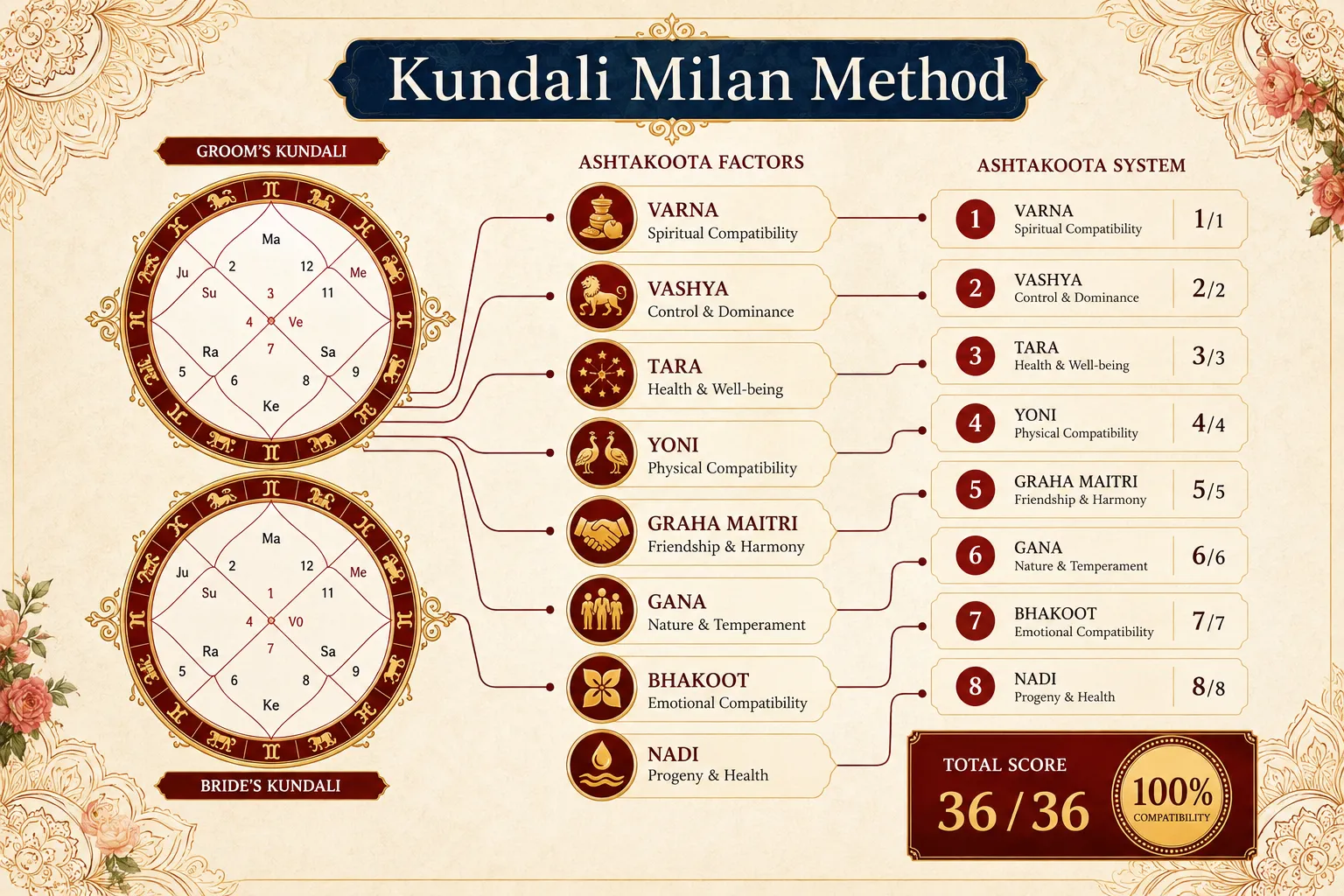
Kundali Milan, or horoscope matching, is a traditional Vedic astrology method used to assess the compatibility between two individuals before marriage. It primarily works by comparing the birth charts (Kundalis) of the prospective bride and groom, with the most common initial step being the Ashtakoota Guna Milan system, which assigns points across eight parameters out of a maximum of 36 to gauge various aspects of compatibility [1].
This system evaluates eight “kootas” or aspects: Varna (spiritual compatibility), Vashya (mutual attraction), Tara (longevity), Yoni (sexual and psychological compatibility), Graha Maitri (intellectual and mental compatibility), Gana (temperament), Bhakoot (mutual love and finances), and Nadi (health and progeny) [10]. Each koota carries a specific number of points, culminating in the 36 Guna Milan score. For marriage, a minimum score of 18 out of 36 is generally considered acceptable, with higher scores suggesting stronger harmony. However, modern couples should not stop their assessment there, as the score is merely an initial filter [10].
What’s a Good Guna Milan Score for Marriage Compatibility?
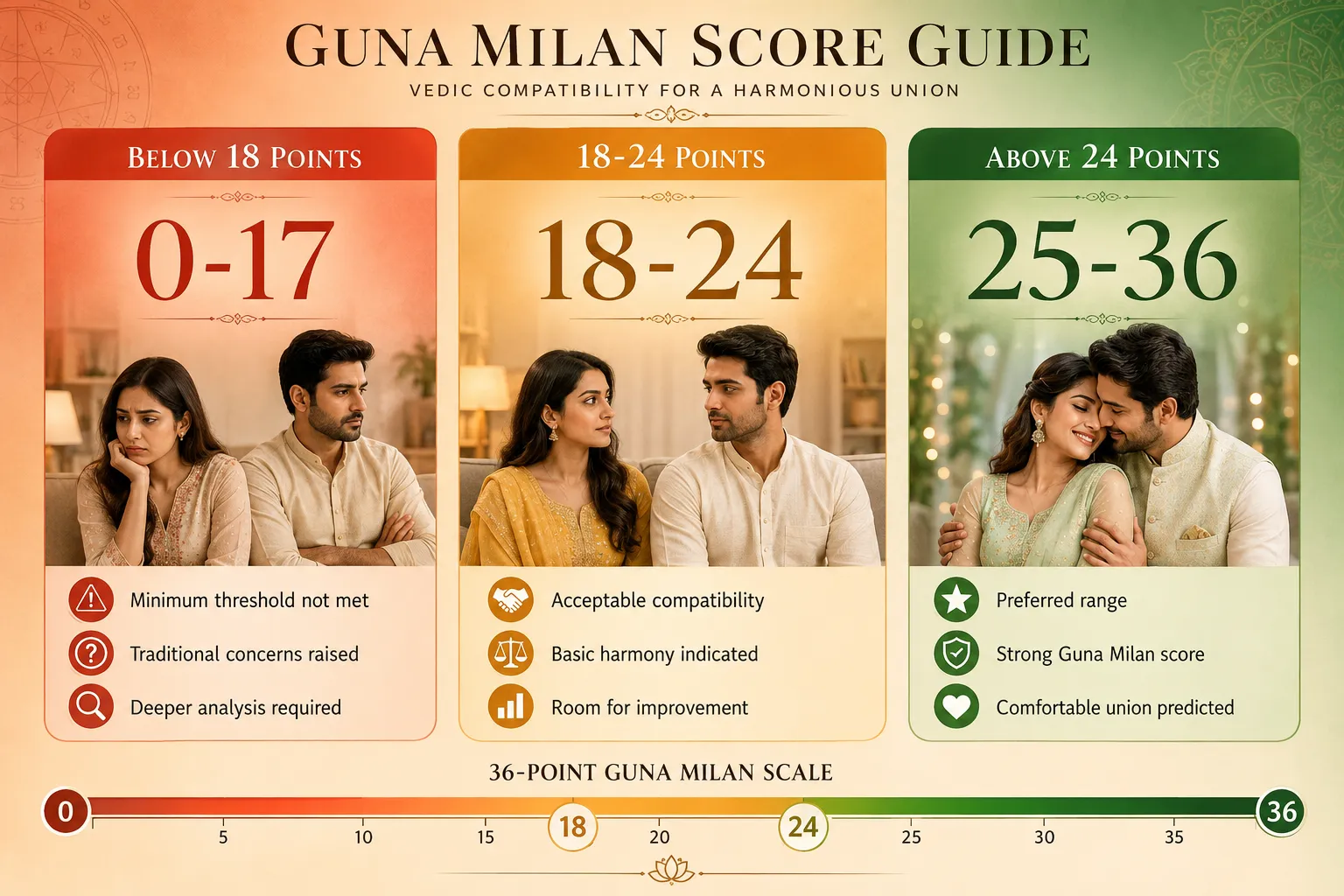
A Guna Milan score of 18 out of 36 is typically considered the minimum threshold for marriage compatibility in Vedic astrology, but scores above 24 are generally preferred for a more comfortable and supportive union. While passing the 18-point mark allows for marriage, it does not guarantee a harmonious relationship [10].
Scores are often categorized:
- 0-17 Gunas: Considered poor, indicating potential instability and high risk [10].
- 18-24 Gunas: Average, suggesting manageable challenges but requiring conscious effort [12].
- 25-32 Gunas: Good, pointing to balanced and supportive compatibility [15].
- 33-36 Gunas: Excellent, indicating a highly auspicious match with strong natural harmony [10].
It’s vital to remember that these numerical guidelines are just one piece of the puzzle. A low score might be mitigated by other strong planetary placements, and a high score can still mask significant underlying issues in the individual charts. Therefore, treating the Guna Milan score as the final verdict is a common “Kundali matching red flag” that modern couples often overlook [11].

7 Red Flags Modern Couples Should Not Overlook
Modern couples, often focused on the convenience of digital tools, frequently miss crucial nuances in Vedic astrology relationship compatibility. Beyond the straightforward Guna Milan score, several deep-seated astrological factors can significantly impact marital harmony, representing “Kundali matching red flags” that demand careful attention in 2026.
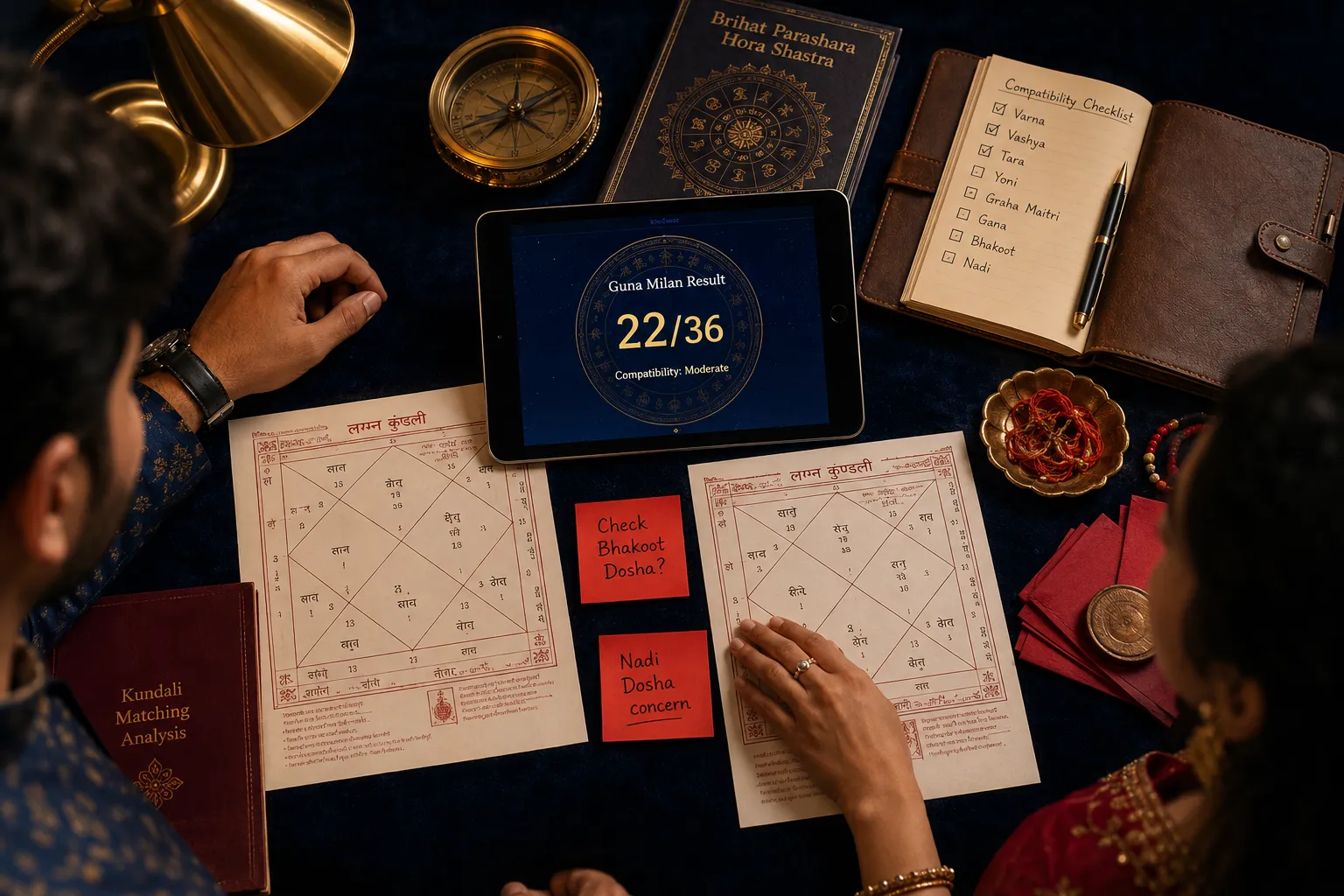
1. Treating the Guna Milan Score as the Final Verdict
The Guna Milan score, while a traditional and useful preliminary compatibility indicator, should never be considered the definitive factor for marriage. This 36-point system primarily measures the compatibility of the Moon signs and Nakshatras, offering insights into temperamental and psychological alignment [10].
A high score can be encouraging, suggesting a foundational level of harmony within the traditional framework. However, it provides limited insight into individual planetary strengths, the overall health of relationship houses, or potential karmic challenges. Conversely, a lower score, especially just above the 18-point minimum, does not automatically doom a marriage; deeper chart analysis may reveal mitigating factors or other areas of strong compatibility [12]. The context of the entire birth chart is crucial, as individual kootas (like Bhakoot and Nadi) carry significant weight regardless of the total score [4].
2. Ignoring Bhakoot Dosha
Bhakoot Dosha, carrying 7 points in the Ashtakoota system, represents the relationship between the Moon signs of both partners and is traditionally considered vital for marital harmony, financial stability, and family well-being. Ignoring it, even with a high overall Guna Milan score, is a significant “Kundali matching red flag” [10].
Specific Moon-sign relationships (e.g., 2/12, 6/8, 9/5 from each other) are traditionally associated with Bhakoot Dosha.
- 2/12 Bhakoot: May indicate financial difficulties, speech issues, or challenges in mutual understanding [14].
- 6/8 Bhakoot: Often linked to health problems, conflicts, and potential separation [8].
- 9/5 Bhakoot: Can suggest issues with progeny, differing values, or lack of intellectual rapport [15].
However, the presence of Bhakoot Dosha does not automatically mean a doomed marriage. Astrologers look for cancellation factors, such as the lords of the Moon signs being friends or occupying auspicious houses, which can significantly mitigate its adverse effects. A thorough analysis evaluates Bhakoot within the context of the entire chart, particularly the strength of the 7th house and its lord.
3. Looking at Nadi Dosha Without Checking the Full Picture
Nadi Dosha, holding the highest weight of 8 points in the Ashtakoota system, is traditionally deemed critical for physical health, genetic compatibility, and the well-being of future progeny. Simply identifying “Nadi Dosha” without further investigation is insufficient for a marriage decision; a deeper look into its specific type and potential cancellations is essential [11].
The three Nadis are Adi Nadi (Vata), Madhya Nadi (Pitta), and Antya Nadi (Kapha), representing the subtle energy channels and temperaments. A Nadi Dosha occurs when both partners belong to the same Nadi.
- Traditional Concerns: Historically, Nadi Dosha has been associated with health issues, infertility, or challenges in child-rearing. Severe cases, particularly involving Madhya Nadi (Naag Nadi), are often considered difficult to cancel [11].
- Importance of Context: Just like Bhakoot, Nadi Dosha isn’t always an absolute barrier. Certain astrological conditions, such as both partners having the same Rashi lord or different Nakshatra padas (quarters), can sometimes lead to cancellation or mitigation of the Dosha [14]. The strength of other compatibility factors and the overall health of the birth charts must be considered before reaching a conclusion.
4. Forgetting the 7th House
The 7th house in a birth chart is the primary indicator of marriage, long-term partnerships, and relationship dynamics. Overlooking the condition of this house, its lord, and any planets influencing it, even with a high Guna score, is a major oversight in Vedic astrology relationship compatibility [9].
A detailed examination of the 7th house involves:
- Condition of the 7th House: Is it strong, weak, or afflicted? A strong 7th house often indicates a harmonious marital life.
- 7th Lord: The planet ruling the 7th house, its strength, placement, and aspects are crucial. A well-placed and strong 7th lord generally bodes well for marriage.
- Planets in the 7th House: Benefic planets (like Jupiter, Venus, well-placed Mercury) can enhance marital happiness, while malefic planets (like Mars, Saturn, Rahu, Ketu, or a debilitated Sun) can bring challenges.
- Aspects to the 7th House/Lord: Positive aspects from benefics can strengthen the house, while negative aspects from malefics can create difficulties. This analysis provides insights into commitment, shared life path, and potential relationship challenges that a simple Guna score cannot capture [9].
5. Ignoring Venus, Jupiter and the Moon
Beyond the Guna Milan score, assessing the individual positions and strengths of Venus, Jupiter, and the Moon in both Kundalis is fundamental for understanding emotional, value-based, and mental compatibility in marriage. These planets are profound significators of relationship dynamics in Vedic astrology.
- Venus: As the natural significator (karaka) of marriage, relationships, love, passion, and marital happiness, a strong and well-placed Venus in both charts indicates mutual affection and a harmonious married life. Afflictions to Venus can suggest challenges in intimacy or enjoyment within the relationship.
- Jupiter: Represents wisdom, values, dharma, children, and the spouse (for females). A strong Jupiter in a chart signifies good judgment, moral values, and blessings in marriage and progeny. Its influence on the 7th house or Venus can elevate the quality of the relationship.
- Moon: Governs emotions, mind, feelings, and overall mental compatibility. The Moon’s placement and condition reveal an individual’s emotional responses and mental equilibrium, which are vital for daily marital interactions. A harmonious Moon relationship between partners often indicates emotional understanding and rapport.
These planets’ interactions and individual strengths offer a nuanced view of emotional and spiritual resonance, going deeper than surface-level compatibility.
6. Overlooking Manglik Considerations
Manglik Dosha, caused by the placement of Mars in specific houses (1st, 4th, 7th, 8th, or 12th) from the Ascendant, Moon, or Venus, is a frequently discussed “Kundali matching red flag” in Vedic astrology relationship compatibility. However, its interpretation often falls victim to fear-based narratives, suggesting automatic divorce or misfortune [3].
- Traditional Concept: Mars is a fiery planet associated with energy, assertiveness, and aggression. Its placement in these houses is believed to affect marriage by potentially causing conflicts, dominance issues, or sudden breaks.
- Nuanced Analysis: Manglik Dosha is not a simple yes/no condition. A proper assessment considers:
- Severity: The intensity of the Dosha varies based on Mars’s sign, house, and aspects.
- Cancellations: Numerous astrological combinations can cancel or mitigate Manglik Dosha, such as Mars being in its own sign, exaltation, or being aspected by benefics [14].
- Double Manglik: If both partners have Manglik Dosha, it can often cancel out the negative effects, leading to a balanced match. Reducing Manglik analysis to a binary outcome ignores the intricate mechanisms of Vedic astrology, emphasizing the need for expert consultation rather than automated checks.
7. Ignoring Navamsa and Planetary Timing
A truly comprehensive Vedic marriage assessment extends beyond the main birth chart (Rashi chart) to include the Navamsa (D9) chart and the influence of planetary timing (Dashas and Transits). Ignoring these elements means missing crucial layers of insight into a relationship’s evolution [4].
- Navamsa (D9) Chart: The D9 chart is considered as important as the Rashi chart for marriage. It reveals the true strength and destiny of planets, particularly concerning marital life. A planet that is strong in the D9 chart (e.g., exalted or in its own sign) can bestow positive results in marriage, even if it appears weaker in the Rashi chart. The compatibility between the Navamsa charts of both partners offers deeper insights into marital happiness, spiritual connection, and the underlying nature of the spouse.
- Planetary Timing (Dashas and Transits):
- Mahadasha and Antardasha: These planetary periods can significantly influence marital experiences. A couple might experience challenges or harmony depending on the Dasha lords operating at a given time and their relationship to the 7th house and marriage significators.
- Major Transits: Slow-moving planets like Saturn, Jupiter, and Rahu/Ketu transiting through crucial houses (especially the 7th) can trigger significant events or shifts in relationship dynamics. Understanding these timings helps anticipate periods that may require greater mutual awareness and effort.
This dynamic analysis acknowledges that relationship experiences are not static; they evolve through different life periods, complementing the initial static compatibility assessment. For further reading, explore “Kundali & Birth Chart Analysis” to deepen your understanding of these complex charts [https://jyotishdev.org/category/kundali-birth-chart-analysis/].
What Does a Good Kundali Matching Analysis Actually Check?
A truly insightful Kundali matching analysis goes far beyond a simple numeric score, offering a holistic view of two individuals’ Vedic astrology relationship compatibility. It provides a comprehensive understanding of potential strengths and challenges.
Here’s a practical checklist of what a good analysis typically examines in 2026:
- Ashtakoot/Guna Milan: The foundational 36-point score, interpreted in context.
- Bhakoot Dosha: Assessment of Moon sign relationships for harmony, finances, and longevity, including cancellation factors [8].
- Nadi Dosha: Examination of genetic and health compatibility, particularly concerning progeny, with consideration for specific types and cancellations [11].
- 7th House: Detailed analysis of the house of marriage, its strength, and afflictions.
- 7th Lord: The ruler of the 7th house, its condition, placement, and aspects.
- Venus: Strength and placement for love, attraction, and marital happiness.
- Jupiter: Position for wisdom, values, progeny, and blessings in marriage.
- Moon: Compatibility of emotional nature, mind, and mutual understanding.
- Manglik Considerations: Nuanced assessment of Mars’s influence, including cancellations and compensatory factors.
- Navamsa (D9): Deeper analysis of marital destiny and the true strength of planets related to marriage.
- Relevant Dashas: Current and upcoming planetary periods impacting the relationship.
- Important Planetary Transits: How major planets might influence relationship dynamics over time.
The goal is not to find a “perfect” Kundali but to understand inherent relationship dynamics, identify areas for growth, and highlight potential challenges that mutual awareness and effort can address. This comprehensive approach differentiates it from simple “Kundali Milan vs. Western Compatibility Tests” [https://jyotishdev.org/blog/matching-compatibility-comparison/].
High Guna Score vs. Strong Overall Compatibility
A high Guna Milan score and strong overall Vedic astrology relationship compatibility are often conflated, but they represent distinct levels of analysis. Understanding their differences is key to making informed marriage decisions.
| High Guna Score | Broader Kundali Analysis |
|---|---|
| Based primarily on Ashtakoota | Examines the complete birth charts (Rashi & Navamsa) |
| Produces a numerical score | Evaluates intricate planetary patterns and house significations |
| Useful as an initial compatibility filter | Provides deeper relationship context and dynamics |
| Does not capture every chart factor | Includes 7th house, planets (Venus, Jupiter, Moon), D9, and timing |
| Should not be treated as a guarantee | Helps identify strengths, potential challenges, and growth areas |
Can a Low Guna Score Still Result in a Good Marriage?
Yes, a lower Guna Milan score does not automatically signify a doomed marriage. While a score below the 18-point threshold often raises concerns, traditional Vedic astrology recognizes that other powerful planetary factors, specific cancellation principles, or strong indicators in the complete charts can significantly alter the interpretation. For instance, if the lords of the 7th house are well-placed or in harmonious aspects, or if Venus and Jupiter are exceptionally strong and supportive, these factors can compensate for a numerically lower Guna score.
Conversely, a high Guna score should not instill false confidence if the broader Kundali matching analysis reveals significant “Kundali matching red flags,” such as severe afflictions to the 7th house, strong Bhakoot or Nadi Doshas without cancellation, or significant malefic influences on key relationship planets. A holistic understanding always triumphs over a single numerical value.
Questions Couples Should Ask Before Marriage
Before making a lifelong commitment in 2026, couples considering marriage should engage in a thorough Kundali matching analysis and ask pertinent questions to ensure they have a complete understanding of their Vedic astrology relationship compatibility.
- Have both complete birth charts (Rashi and Navamsa) been analyzed, not just the Guna Milan score?
- Was the 7th house and its lord examined for marital strength and potential challenges?
- Were Bhakoot Dosha and Nadi Dosha interpreted in context, considering specific types and potential cancellation principles?
- Was Manglik Dosha properly assessed, including its severity, cancellations, and compensatory factors, rather than a simple ‘yes/no’?
- Were the positions and strengths of Venus, Jupiter, and the Moon analyzed for emotional, value-based, and mental compatibility?
- Were current and upcoming Dashas (planetary periods) and significant transits reviewed to understand evolving relationship experiences?
- Were potential strengths and challenges of the relationship explained clearly, rather than just providing a score or dire predictions?
- What remedies, if any, are suggested for identified astrological challenges, and are they practical?
- How does this Vedic analysis align with our practical, real-world understanding of our relationship?
Asking these questions ensures a deeper, more informed decision-making process, moving beyond superficial astrological readings. For an initial step, understanding “How to Read Your Kundali: A Beginner’s Step-by-Step Guide” can be helpful [https://jyotishdev.org/blog/how-to-read-your-kundali-a-beginners-step-by-step-guide/].
What Kundali Matching Can, and Cannot, Tell You
Kundali matching is a powerful tool within Vedic astrology relationship compatibility, offering profound insights, but it’s essential to understand its limitations.
What it can traditionally help explore:
- Emotional compatibility: Insights into mental rapport and emotional responses.
- Relationship dynamics: Understanding the inherent strengths and weaknesses of the union.
- Potential areas of friction: Identifying astrological patterns that may lead to disagreements.
- Traditional marriage indicators: Assessing factors like longevity, progeny, and mutual well-being.
- Periods requiring greater awareness: Highlighting times when relationship challenges might be more pronounced due to planetary influences.
What it cannot guarantee:
- A perfectly happy marriage: Human effort, communication, and mutual respect are always paramount.
- Permanent compatibility: Relationships evolve, and personal growth plays a huge role.
- Absence of disagreements: All couples face challenges; astrology helps understand their nature.
- Financial success: While Bhakoot can hint at financial harmony, individual efforts are key.
- The future behavior of either partner: Free will and conscious choices shape actions.
Ultimately, communication, shared values, emotional maturity, realistic financial expectations, and unwavering mutual respect remain the critical pillars of any healthy and lasting marriage.
Get a Human-Analyzed Vedic Kundali Matching
Before making a lifelong commitment, don’t stop at the Guna Milan number. Get both Kundalis examined together, including the 7th house, Bhakoot Dosha, Nadi Dosha, planetary strengths (Venus, Jupiter, Moon), Manglik considerations, Navamsa (D9), and relevant Dashas, to understand the complete compatibility picture. A detailed, human-analyzed Vedic Kundali Matching consultation provides nuanced insights far beyond what any automated calculator can offer. Understand the strengths, anticipate potential challenges, and gain clarity on your journey together.
Conclusion
The pursuit of “Kundali Milan for marriage” in 2026 often begins and ends with the Guna Milan score, a significant “Kundali matching red flag” in itself. While this 36-point system offers a foundational overview of compatibility, true Vedic astrology relationship compatibility requires a much deeper dive into the intricate patterns of individual birth charts. Overlooking critical factors such as Bhakoot Dosha, Nadi Dosha, the condition of the 7th house and its lord, the strength of Venus, Jupiter, and the Moon, Manglik considerations, and the insights from the Navamsa (D9) chart can lead to unforeseen challenges in married life. A meaningful Vedic assessment looks beyond the number to understand how the two charts interact, where inherent strengths exist, where potential challenges may arise, and which factors deserve thoughtful attention before marriage. This holistic approach empowers couples to build a relationship founded on awareness and mutual understanding, rather than misplaced confidence in a single score.
FAQ
What are the most important doshas to check in Kundali matching?
The most critical doshas to check in Kundali matching are Bhakoot Dosha and Nadi Dosha due to their significant weight in the Ashtakoota system and their implications for marital harmony, finances, health, and progeny. Manglik Dosha also requires careful assessment.
How accurate is Vedic astrology for relationship compatibility?
Vedic astrology, when analyzed comprehensively by an experienced astrologer, can offer profound insights into relationship compatibility, highlighting inherent dynamics, strengths, and potential challenges. Its accuracy depends on the precision of birth details and the expertise of the interpreter, as it provides a framework for understanding rather than deterministic predictions.
What’s the difference between Guna Milan and Dosha matching?
Guna Milan refers to the 36-point compatibility scoring system (Ashtakoota), which provides a numerical sum of various compatibility factors. Dosha matching, on the other hand, involves specifically analyzing and addressing individual planetary afflictions or “red flags” like Bhakoot Dosha, Nadi Dosha, and Manglik Dosha, which can exist even with a high Guna score.
Should you ignore Kundali matching red flags if you love someone?
Ignoring Kundali matching red flags, especially severe ones like unmitigated Bhakoot or Nadi Dosha, is generally not advised, even in love marriages. While love is crucial, these astrological indicators highlight potential areas of significant challenge that may impact the relationship’s long-term stability and harmony. It’s better to understand and address them proactively, possibly seeking remedies or preparing for specific challenges, rather than dismissing them.
Can Nadi Dosha be remedied or is marriage impossible?
Nadi Dosha can sometimes be remedied or mitigated, and marriage is not necessarily impossible. Specific astrological conditions, such as having the same Rashi lord or different Nakshatra padas, can cancel the Dosha. Remedies often involve specific prayers or rituals. A qualified astrologer can determine the severity and potential for cancellation or mitigation.
Kundali matching for love marriage vs arranged marriage differences?
The principles of Kundali matching remain the same for both love and arranged marriages. However, in love marriages, couples often prioritize their existing emotional connection, which might lead them to overlook or seek mitigations for astrological incompatibilities that would be deal-breakers in an arranged setup. In arranged marriages, Kundali matching often serves as an initial filter, with less emotional investment upfront.
What percentage Guna Milan is acceptable for marriage?
A Guna Milan score of 50% or 18 out of 36 is traditionally considered the minimum acceptable for marriage. Scores of 24 and above are generally preferred for a harmonious union. However, this is a numerical guideline and should always be part of a broader, deeper Kundali analysis.
References
Jyotish Dev brings authentic, human astrologers-analyzed Vedic astrology from Bhubaneswar to the world. We decode your Kundali to provide profound life clarity globally.
